Bioheat Fuel: What the Blend Means
Bioheat fuel is heating oil blended with biodiesel; the number after the B is the biodiesel percent, and New York requires at least B10 statewide while we found no blend mandate in Maine, New Hampshire or Vermont.
Written by the Fill Pipe desk from state, federal and maker documents · how the pages are made · Updated
Who’s behind the links: Fill Pipe is run by the people who own Plumbing Supply and More, SoftPro Water Systems and Quality Water Treatment, and it has a working tie to Central Plumbing & HVAC. No business pays to appear here. Figures and safety steps on this page come from state energy offices and environmental agencies, federal agencies (EIA, IRS, CPSC, CDC), the propane and heating-oil industries' own safety programs, and equipment makers' manuals, read in October 2026. Fill Pipe sells no fuel and services no equipment. Owners and outbound links
First tap of the season
- Blends up to B5 are considered conventional heating oil under ASTM D396, according to the DOE/NREL biodiesel handling report.
- ASTM D396-25 includes B6 to B20 grades for home and small industrial burners; NORA reports a 2026 revision, D396-26a, adds B21 to B50.
- New York law requires heating oil sold anywhere in the state to contain at least 10% biodiesel since July 1, 2025, rising to 20% on July 1, 2030; kerosene is exempt.
- We found no blend mandate in Maine, New Hampshire or Vermont as of October 2026; Vermont's Clean Heat Standard was not authorized (PUC order, January 30, 2026).
- NORA's testing found common nitrile seals in home burner pumps perform the same or better on B20 than on regular No. 2 oil.
- NREL estimates more than 400,000 homes were using B20 blends as of 2023.
Stop and call if
- You smell strong oil or exhaust, or see smoke or soot at the burner after a delivery.
- The burner won't start, or stops again after one press of the reset.
- You see oil weeping at the filter, pump or fittings, or a wet spot under the tank.
- The CO alarm sounds or anyone feels dizzy or sick: everyone outside, then call 911.
- If you're unsure, stop and call your supplier or a licensed technician.
What is bioheat fuel?
Bioheat fuel is ordinary No. 2 heating oil with biodiesel mixed in, delivered through the same fill pipe and burned in the same burner. Biodiesel is made from plant oils, animal fats or recycled cooking oils and greases, according to the DOE/NREL Biodiesel Handling and Use report.
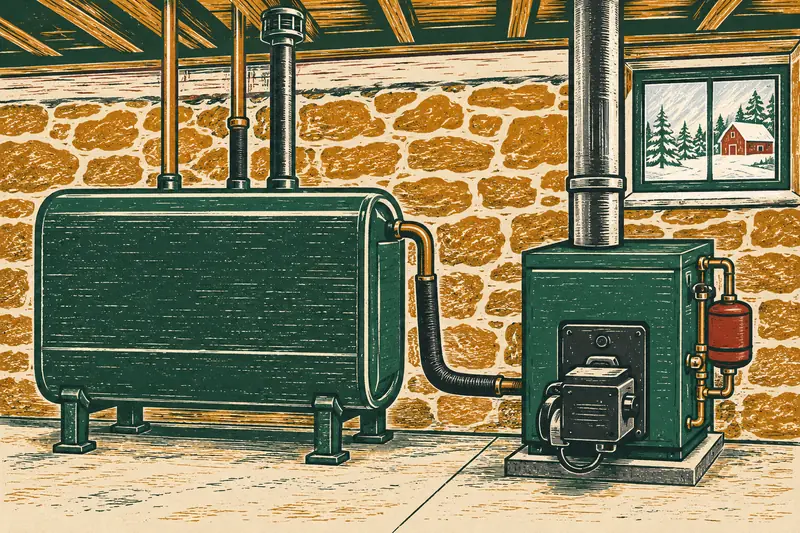
Most homes on bioheat never notice a change at the tank. NREL notes that in most conversions to a biodiesel blend the tank isn't replaced or cleaned; the dealer simply starts delivering the blend into an existing tank that already holds heating oil. Because the blend goes in like any delivery, the way to know what you have is to ask your dealer.
What do B5, B20 and higher blends mean?
The number after the B is the percent of biodiesel by volume: B5 is 5% biodiesel, B20 is 20%, and B100 is pure biodiesel. What changes as the number climbs is which ASTM grade covers the fuel.
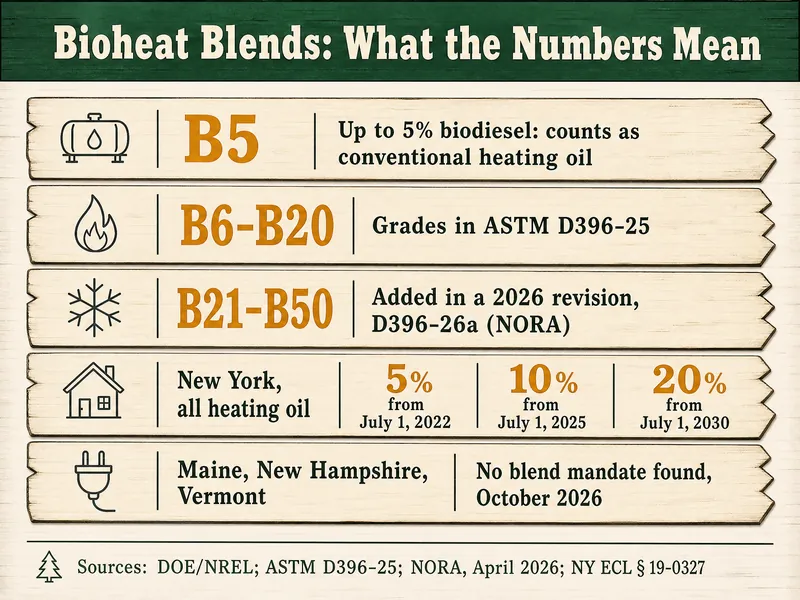
- Up to B5. NREL says ASTM D396 allows up to 5% biodiesel in No. 1 and No. 2 heating oil, and "blends up to B5 are considered conventional heating oil."
- B6 to B20. The ASTM D396-25 scope lists B6–B20 grades as middle distillate and biodiesel blends "for use in domestic and small industrial burners."
- B21 to B50. NORA reported in April 2026 that a 2026 revision, D396-26a, adds grades from 21% to 50% biodiesel.
NREL estimates that, as of 2023, more than 400,000 homes were using B20 blends and about 10,000 were using B50. Above B20 is still the edge of the market, and the equipment questions below matter more there.
Which states require bioheat?
New York is the only state in Fill Pipe's region that requires bioheat, and its schedule is set in Environmental Conservation Law § 19-0327. Since July 1, 2022 all heating oil sold for use in any building in the state has had to contain at least 5% biodiesel; since July 1, 2025, at least 10%; and from July 1, 2030, at least 20%. Nassau, Suffolk and Westchester counties started earlier, at 5% from July 1, 2018.
The same section says the minimums don't apply to kerosene, lets the governor temporarily suspend them by executive order, and leaves room for New York City to require the same or higher percentages.
We found no blend mandate in Maine, New Hampshire or Vermont as of October 2026. Vermont's Clean Heat Standard, a clean-heat credit program rather than a blend rule, isn't in effect: the Vermont PUC's order closing the case, dated January 30, 2026, says it "is not authorized to implement the Clean Heat Standard."
| State | Requirement | Source |
|---|---|---|
| New York | At least 5% from July 1, 2022; 10% from July 1, 2025; 20% from July 1, 2030; kerosene exempt | NY ECL § 19-0327 |
| Maine | No blend mandate found | Fill Pipe search of state law, October 2026 |
| New Hampshire | No blend mandate found | Fill Pipe search of state law, October 2026 |
| Vermont | No blend mandate found; Clean Heat Standard not authorized | Vermont PUC order, January 30, 2026 |
| Connecticut (context) | 10% by July 1, 2025, stepping to 50% by July 1, 2035 | Conn. Gen. Stat. § 16a-21b |
| Rhode Island (context) | B20 by July 1, 2025; B50 by July 1, 2030 | Rhode Island General Laws § 23-23.7-4 |
Does bioheat work in an older burner?
Bioheat at B20 and below generally works in older home burners, and the evidence is fairly direct. NORA's equipment testing found that common nitrile seals in typical home burner pumps perform the same or better on B20 than on conventional No. 2 oil, and that older pumps rated only for straight oil were acceptable up to B20.
NREL agrees that most legacy equipment isn't damaged by biodiesel, while recommending manufacturer-approved equipment for blends. Burners are safety-listed under UL 296, which NREL says now includes test protocols for blends up to B100, and several burner makers have gone through that listing.
Two cautions. Pure biodiesel is a strong solvent that can loosen old varnish and sediment, which NREL says shows up first as more filter plugging; it adds that this "should not be an issue for B20 or lower blends." And B100 gels at higher temperatures than most heating oil, which is one reason high blends in an outdoor tank need a conversation with your dealer. If your burner, boiler or furnace is under warranty, New York's statute says a dealer can't sell a blend that would void it unless the dealer warrants in writing that the blend is covered.
Bioheat by the numbers
- 5%biodiesel or less still counts as conventional heating oilDOE/NREL
- 20%New York's minimum blend from July 1, 2030NY ECL § 19-0327
- 400,000+homes using B20 blends, 2023 estimateDOE/NREL
- About 10%less soot from B20 in home heating systemsDOE/NREL
Does bioheat change cost or delivery?
Bioheat doesn't change how delivery works: the same truck, the same fill pipe and the same tank, on the same automatic or will-call plan described on the heating oil delivery plans page. Cost is harder to pin down, because the state price surveys Fill Pipe quotes report heating oil, kerosene and propane, not blends.
For reference, EIA's residential numbers dated 10/26/26, before taxes, show Maine oil averaging $6.040 per gallon and New York oil $6.441. Whether a blend costs more or less than straight oil from your dealer is a question for the dealer, in writing.
Heat per gallon shifts a little at high blends. NREL's table lists pure biodiesel at 119,550 Btu per gallon against 139,000 for typical heating oil, so a high blend carries somewhat less heat per gallon; at B5 the difference is small. NREL also reports that biodiesel in home heating systems cut soot by roughly 10% for B20 and as much as 60% for B100, and less soot on the heat exchanger is one thing your technician will see at the yearly oil furnace and boiler service.
What should you ask your dealer?
Ask your dealer what blend they deliver, whether it changes through the winter, and what it means for your equipment. A short written answer is worth having, especially in New York where the blend is required.
Questions for the dealer
What blend is in my tank?
Ask for the percent, B5, B10, B20 or higher, and whether it changes in winter.
Is it priced differently?
Ask for the per-gallon price of the blend against straight No. 2 oil, with the date.
Does it affect my warranty?
In New York, a dealer can't sell a blend that voids your burner or boiler warranty unless the dealer warrants in writing that it's covered.
Should my filter be changed sooner?
Ask whether the first season on a higher blend calls for an extra filter check, given NREL's note on old tank sediment.
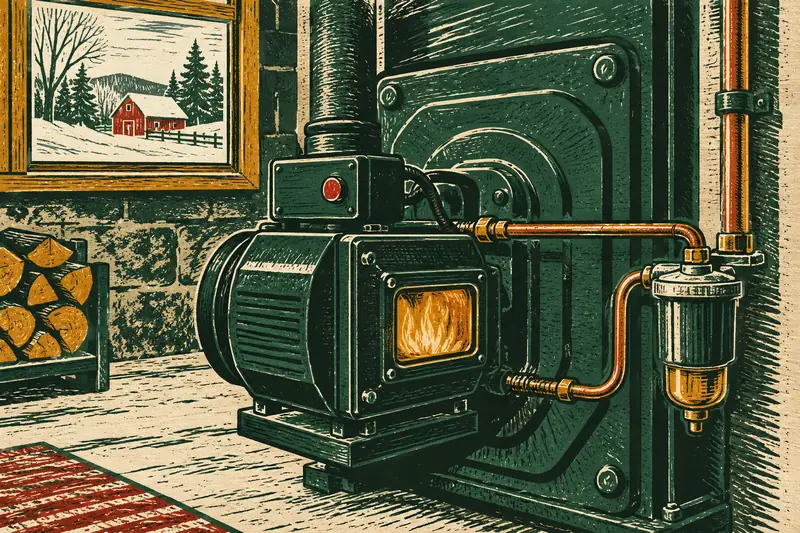
The burner's oil pump is the part NORA tested with B20. Pumps are a technician's part; the listing below shows what home burner oil pumps look like, and your technician specifies any replacement for your burner.
Scaler's notes: how this page was put together
This page is based on the DOE/NREL Biodiesel Handling and Use report (sixth edition), the ASTM D396-25 scope page, NORA's April 2026 report on D396-26a and its equipment testing page, New York ECL § 19-0327, Connecticut and Rhode Island statutes for context, the Vermont PUC's January 30, 2026 order, and EIA's weekly residential heating oil prices dated 10/26/26, all read October 2026. We didn't read the full ASTM standard text or New York City's local law, and no source we found gives a bioheat price by state, so none is shown.
Questions from the woodshed
Is bioheat better for your burner than regular heating oil?
NREL reports less soot, about 10% less for B20, and NORA found burner pump seals do as well or better on B20. "Better" for a given burner is a question for your technician and the burner maker.
Do you need a new tank to switch to bioheat?
Usually not. NREL says most conversions simply start delivering the blend into the existing tank, though replacing or cleaning a tank in poor condition may be wise first; see the 275-gallon oil tank.
Does New York's mandate apply to kerosene in an outdoor tank?
No. ECL § 19-0327 says the minimum biodiesel content doesn't apply to kerosene.
Can you mix bioheat with the oil already in your tank?
Yes; NREL describes that as the common way homes switch. Tell your technician at the next service so filter changes can be watched.
Does bioheat smell different?
None of the primary sources we read describes a household odor difference. A strong oil smell in the house is a problem with any fuel; see oil smell in the house.
Will Maine, New Hampshire or Vermont require bioheat soon?
We found no blend mandate in Maine, New Hampshire or Vermont as of October 2026, and can't predict legislation. Fill Pipe re-checks state rules when they change.
More on oil heat