Propane Tank Inspection
Propane tank inspection is the supplier's or a qualified technician's job, done when you switch companies, after a run-out and on the schedule your contract sets; your part is watching, not testing.
Written by the Fill Pipe desk from state, federal and maker documents · how the pages are made · Updated
First tap of the season
- PERC's safety booklet says to use a qualified professional for any service or change to the gas system, "including tanks, cylinders, pipes, and their components."
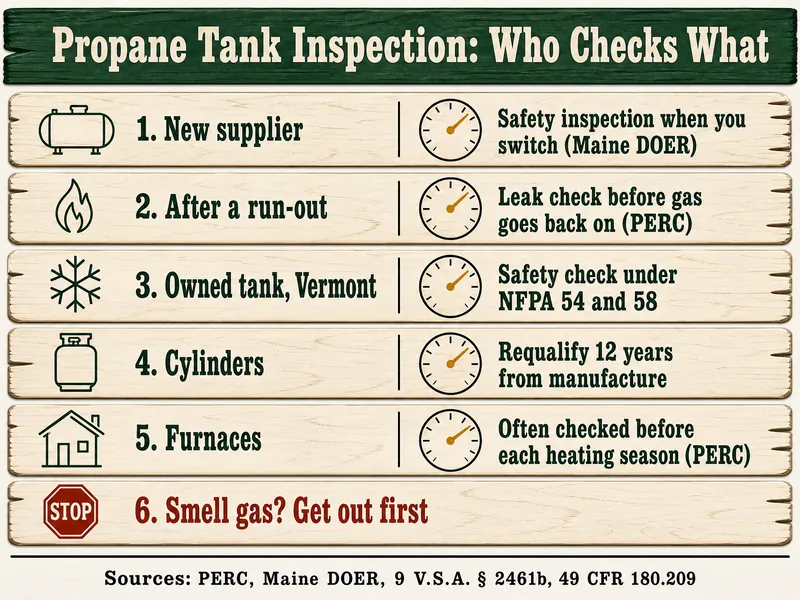
- Maine DOER says a new propane company will require a safety inspection before switching you over, and will charge for it.
- Vermont law, 9 V.S.A. § 2461b, ties delivery to a customer-owned tank to a seller's check against the NFPA 54 and 58 codes.
- After any run-out, PERC says a qualified person must leak-check the system before the gas goes back on.
- Grill-size DOT cylinders get a first requalification 12 years after they are made, and later ones on a cycle set by the test used (49 CFR 180.209).
- Vermont's CP 111 lists a "leak or pressure test" as a charge a propane seller may bill.
Get out or stop and call
- Smell propane inside: get everyone out now. Touch no light switches, phones, flames or appliances, and don't start a car or garage door inside. Don't look for the leak. From outside and well away, call 911, then your propane supplier, and stay out until they say it's safe.
- A propane gas detector alarm, even with no smell: treat it as an emergency and leave (PERC).
- A tank that has moved, or gas lines bent or broken after a storm: keep away and call your supplier.
- Gas went off for any reason: don't turn anything on at the tank. A qualified person leak-checks first.
- If you're unsure, stop and call your supplier or a licensed technician.
Who does a propane tank inspection?
Your propane supplier or another qualified professional does it, never the homeowner. The PERC safety booklet says "Safety codes in every state require a 'qualified person' for certain tasks," and lists any service or change to tanks, cylinders, pipes and their parts among the jobs for a professional.
The states back that up in their own ways. Vermont's Division of Fire Safety says everyone engaged in the inspection, installation and service of propane systems must be certified. In Maine, the law requires a Fuel Board license to install or service propane equipment (owner-occupied single-family homes have a narrow exception, and that work must still meet the Board's rules); hire a licensed technician. In New York we found no statewide license rule, so use a qualified, insured service company; some cities and counties license this work.
What does the supplier check?
The supplier checks that the tank, regulator, piping and appliances hold gas without leaking and are set up to code before it delivers or restores service. No state rule we read lists every item, but the codes behind the check are named: Vermont's propane statute refers to a safety check "in accordance with NFPA 54 (National Fuel Gas Code) and NFPA 58," the two codes that cover gas piping and propane storage.
The visit comes at predictable moments. Maine DOER's propane pricing booklet says a new company will require a safety inspection when you switch, and lists "annual leak detection and safety inspection" among the fees to ask about. Vermont's CP 111 names a "leak or pressure test" as a chargeable item, and an unpaid one can be grounds for disconnection. The switching propane companies page covers the rest of a changeover.
| Situation | Who checks | What the source says |
|---|---|---|
| Switching to a new supplier | The new company | Maine DOER: it "will require a safety inspection" and charge for it |
| Delivery to a tank you own, Vermont | The seller | 9 V.S.A. § 2461b(f)(1): a check against NFPA 54 and 58 |
| After a run-out or shut-off | Supplier or qualified professional | PERC: leak check before the gas goes back on |
| After a suspected leak | Supplier or qualified professional | PERC: whole system checked before using appliances again |
| Appliance upkeep | Qualified professional | PERC: follow the maker's schedule; furnaces often before each season |
When do cylinders need requalifying?
Portable cylinders, such as a 20-pound grill tank, are requalified 12 years from manufacture, then at intervals that depend on the test method. PERC's lesson on storing propane says cylinders are "qualified (safety-tested and marked with a date) when they are made," and that a cylinder can't be refilled if it isn't inspected before the due date.
Federal rule 49 CFR 180.209 sets the later intervals. After the first 12 years, a cylinder retested by proof pressure is due every 10 years, and one requalified by external visual inspection is due every five. The tank in your yard is a different kind of container: PERC calls home tanks ASME storage tanks, and the 12-year cylinder rule doesn't apply to them.
PERC's lesson also lists what a cylinder inspection looks for: cracks or leaks, bulging, major denting or gouging, defective valves, leaking pressure relief devices, damaged valves or foot rings, and evidence of abuse. A refill station or exchange cage handles that check. Store cylinders outdoors in the meantime, as the storing fuel safely page explains.
What can a homeowner watch for?
You can watch, listen and smell, and call when something is off; anything with a wrench in it belongs to the supplier. Read the gauge periodically, as PERC advises, and note readings with dates; the propane gauge page shows how to turn them into gallons. PERC's booklet treats an unexplained hiss near the tank, or gas use running ahead of what you expect, as possible signs of a leak.
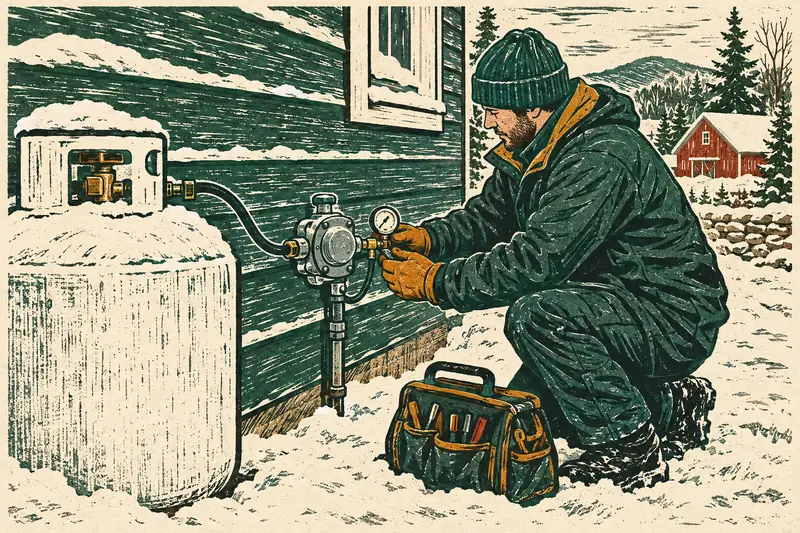
Winter adds chores that need no tools. Keep heavy snow and ice off piping, regulators and meters, using a broom rather than a shovel, and clear the walkway and tank area so the driver can reach the tank. PERC's booklet also says to check the tank and system after high winds or heavy rain and to contact your retailer right away if anything looks damaged. Never put a heat source on a cold tank.
A propane gas detector adds protection. PERC says detectors can catch leaks you don't smell, but never ignore the smell even if the detector is quiet. If the smell comes first, the propane smell page has the full get-out steps.
What about an owned tank?
If you own the tank, you choose who fills it, but that company will still check the system before it delivers. In Maine, the law lets only the owner or someone the owner authorizes in writing fill a propane container, and the Maine AG says owners "are free to shop for the best price and service." Maine DOER also advises checking that an owned tank is covered under your homeowner's insurance before you buy one.
Vermont's statute obliges a seller to fill a tank you own once you prove ownership and its NFPA 54 and 58 check is done. In New Hampshire, RSA 339:79 bars a dealer from charging rental or lease fees for a tank owned by the consumer. The leased or owned tank page compares the two setups in each state.
What happens at a system check?
At a system check, the technician confirms the system holds gas before anything is lit, then restores service and, if needed, lights pilots. PERC's checklist puts the order plainly: after a run-out or interruption, have your propane retailer or a qualified professional "perform a leak check, restore gas service, and, if needed, light your pilot lights." Vermont's CP 111 calls the billable version a leak or pressure test.
Plan to be home, with a clear path to the tank and to every gas appliance indoors. Ask for the result in writing, what it covered, and whether the fee repeats each year. Leave pilots, valves and connectors to the technician; PERC says not to install, loosen or disconnect appliance connectors yourself. The ran out of propane page covers the run-out case step by step.
Inspection numbers
- 12 yearsfrom manufacture to a cylinder's first requalification49 CFR 180.209
- 5 yearsinterval after the first 12 when a cylinder is requalified by visual inspection49 CFR 180.209
- 2 codesNFPA 54 and NFPA 58 named for Vermont owned-tank safety checks9 V.S.A. § 2461b
- 0gas restarts at the tank a homeowner should attempt after a run-outPERC
Questions to ask before the check
What does the inspection cover?
Tank, regulator, piping, appliances, or only the tank connection? Ask for the list.
Is it a yearly fee?
Maine DOER lists annual leak detection and safety inspection among the fees to ask about.
Can I get the result in writing?
A written result helps if you switch companies or sell the house.
Who lights the pilots afterward?
The technician should, once the leak check passes.
Scaler's notes: how this page was put together
This page draws on PERC's safety booklet and its lesson on storing propane, 49 CFR 180.209, Maine DOER's 2026-2027 propane pricing booklet, the Maine AG's heating fuel page, 10 M.R.S. § 1658-A, Vermont's 9 V.S.A. § 2461b and CP 111, RSA 339:79 in New Hampshire and the Vermont fire safety division's gas certification page, all read in October 2026. We found no primary checklist of every item in a home tank inspection, no requalification rule for ASME home tanks and no tank lifespan, so we give none. We left out leak-test steps of any kind.
Questions from the woodshed
How often should a propane tank be inspected?
No state rule we read sets a yearly inspection for a home propane tank. Checks are triggered by events: a new supplier, a run-out or shut-off, a suspected leak, or the schedule in your contract. Ask whether your supplier's fee covers an annual check.
Does my grill cylinder need inspecting?
Yes, on a schedule. Its first requalification falls 12 years after it was made, with later ones set by the test method, and PERC says it can't be refilled past its due date without that inspection. PERC says cylinders are marked with a date when made; ask the refill or exchange station to read it for you.
Can I leak-test my own propane system?
Leave the home system to your supplier or a qualified technician. PERC says a qualified professional must check for leaks when gas is turned back on, and that the homeowner is never the one to restart gas at the tank. If you smell gas, leave first.
Will a new propane company inspect my tank for free?
Not necessarily. Maine DOER says the new company will require a safety inspection and charge you for it. Ask for the fee in writing before you sign.
What if the inspection fails?
Ask the supplier what failed, what has to be fixed before gas service, who may do the repair and what it costs, and get those answers in writing. Don't use the appliances until the system has been checked again.
Do I need to be home for a propane safety check?
Usually yes, because the technician has to reach the appliances inside as well as the tank. Clear snow from the path and the tank area first.
Keep reading

Back to the tank-gauge front page