Propane Tank Sizes for Homes
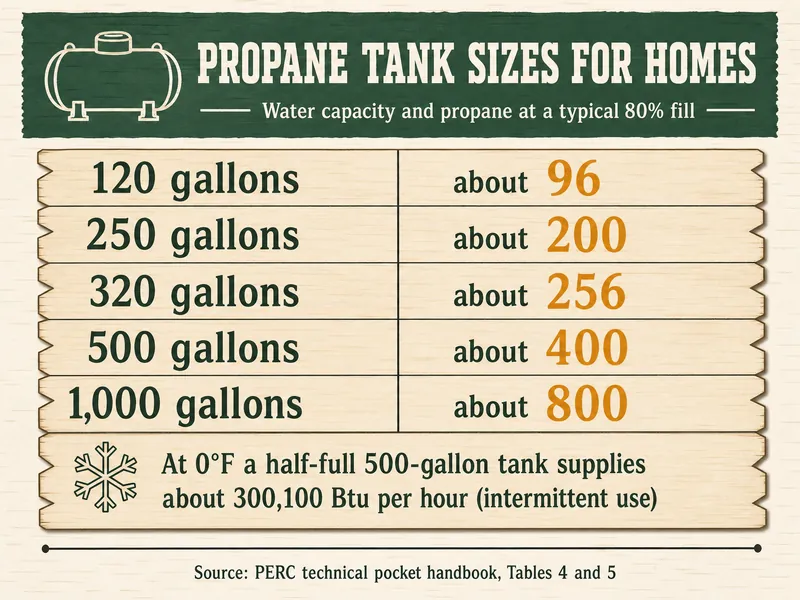
Propane tank sizes for homes run from 120 to 1,000 gallons of water capacity, and a typical fill puts about 80 percent of that in the tank as propane.
Written by the Fill Pipe desk from state, federal and maker documents · how the pages are made · Updated
First tap of the season
- PERC's tank table lists 120, 250, 320, 500 and 1,000-gallon home tanks; a 500-gallon tank is about 38 inches across and 10 feet long.
- Sizes are water capacity: at a typical fill of about 80 percent, a 500-gallon tank holds about 400 gallons of propane.
- PERC says your supplier needs the total Btu load of your appliances to size and place the tank.
- At 0°F, a half-full 500-gallon tank can supply about 300,100 Btu per hour under intermittent use (far less under a continuous load), according to PERC's vaporization table.
- Maine DOER's propane price survey assumes a household burning 900 gallons or more a year; light users such as cooking-only homes are charged a higher rate.
- Small DOT cylinders run on their own federal clock: requalification 12 years after manufacture, then on a schedule tied to the test used (49 CFR 180.209).
Stop and call
- Smell propane inside: get everyone out now. Touch no light switches, phones, flames or appliances, and don't start a car or garage door inside. Don't look for the leak. From outside and well away, call 911, then your propane supplier, and stay out until they say it's safe.
- A tank that has shifted, or bent or broken gas lines after a storm or a plow strike: stay away from it and call your supplier from a distance.
- Never move, connect, disconnect, fill or heat the home tank yourself; that is the supplier's job, and small cylinders are filled or exchanged by the refill location.
- Keep grill cylinders outdoors, never in a basement, garage or shed.
- If you're unsure, stop and call your supplier or a licensed technician.
Which propane tank sizes do homes use?
Homes use tanks from 120 gallons up to 1,000 gallons, with 250, 320 and 500 in between. Those are the residential sizes in Table 4 of PERC's technical pocket handbook, which notes that the dimensions are only for guidance because sizes vary by manufacturer.
| Tank size (water capacity) | Outside diameter | Length | Propane at a typical 80% fill |
|---|---|---|---|
| 120-gallon tank | 24 in | 5 ft 6 in | about 96 gal |
| 250-gallon tank | 30 in | 7 ft 8 in | about 200 gal |
| 320-gallon tank | 32 in | 9 ft | about 256 gal |
| 500-gallon tank | 38 in | 10 ft | about 400 gal |
| 1,000-gallon tank | 40 in | 16 ft 8 in | about 800 gal |
The tank you have is often the supplier's tank, not yours. If it is leased, only the owning company may fill it in Maine and most states, as the leased or owned tank page explains, and a change of size usually means a new lease.
How much does each size really hold?
Each tank holds about 80 percent of its listed size as propane, because the listed size is water capacity and the fill stops short to leave room for expansion. PERC's lesson on storing propane gives the reason: filling to less than 100 percent allows for liquid expansion on hot days. So the usable figure for planning is about 96 gallons in a 120, 200 in a 250, 400 in a 500 and 800 in a 1,000.
That gap matters when you compare delivery plans and minimum orders. In Vermont, Consumer Protection Rule 111 limits the minimum delivery a seller can require when it offers a reasonable payment plan: 125 gallons for a 250-gallon tank, 175 for a 325, 225 for a 500 and 300 for a 1,000. For tanks under 250 gallons, the minimum can't exceed 100 gallons or the tank's capacity, whichever is less. To read your own level, see how the percent gauge works.
Which size fits whole-house heat?
The right size for whole-house heat comes from your appliances' total Btu load and the coldest weather you get, not from a rule of thumb. PERC's handbook says your propane provider needs the total Btu load to design the system, "including determining the proper sizing and distance placement of the propane tank," and that sizing an ASME tank means considering the lowest winter temperature at the location.
Cold matters because a tank makes vapor more slowly as it gets colder or emptier. PERC's Table 5 shows how much a half-full aboveground tank can supply under intermittent use: at 0°F, about 180,600 Btu per hour from a 250-gallon tank, 300,100 from a 500 and 534,500 from a 1,000. At -20°F those fall to 145,800, 242,300 and 431,600. PERC adds that under continuous load, the figures should be multiplied by 0.25.
Example, using PERC's approximate appliance inputs: a single-family boiler for space and water heating (120,000 Btu per hour), a freestanding range (65,000) and a dryer (35,000) add up to 220,000 Btu per hour. By Table 5, a 250-gallon tank falls short of that at 0°F, while a 500-gallon tank covers it even at -20°F. Your supplier will use your real nameplate ratings, and may add room for appliances you plan to add later.
Annual volume also affects price. Maine DOER's survey prices assume at least 900 gallons a year, and its propane pricing booklet says dealers price in tiers, with the per-gallon rate rising as yearly volume falls.
Size and supply numbers
- 400gallons of propane in a 500-gallon tank at a typical fillPERC tank table, Fill Pipe arithmetic
- 300,100Btu per hour from a half-full 500-gallon tank at 0°F, intermittent usePERC
- 0.25multiplier on those figures under continuous loadPERC
- 900gallons a year assumed in Maine DOER's propane price surveyMaine DOER
Aboveground or underground?
Both work for heating; a buried tank gives steadier vapor supply in deep cold, while an aboveground tank costs nothing to dig and keeps every fitting in view. PERC's handbook says underground tanks see a more constant temperature year-round, which stabilizes vaporization, and that placing a container below grade can ease wide swings in vapor pressure. It also says burial depth and location matter, and the spot should keep the delivery truck from driving over a septic tank or other buried features.
State law treats buried tanks differently when you leave a supplier. In New Hampshire, RSA 339:79 bars removal and pump-out fees only after an underground tank has been on the premises 60 months, against 24 months for an aboveground one, and requires dealers to offer the option to buy an underground tank. In Vermont, 9 V.S.A. § 2461b gives the seller 30 days to remove an underground tank instead of 20.
How are small cylinders different?
Small cylinders, such as the 20-pound grill tank, are portable DOT containers with their own rules, and they are not a substitute for a home heating tank. PERC says cylinders must be requalified, and federal rule 49 CFR 180.209 sets the schedule: a first requalification 12 years after the cylinder was made, and later ones on a cycle set by the test used. A cylinder can't be refilled once its date has passed without that inspection.
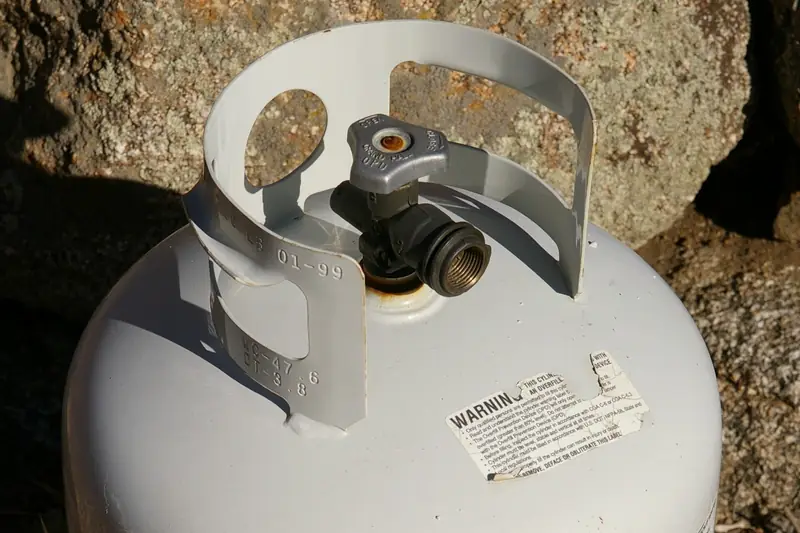
PERC's safety booklet says to use only cylinders with an overfill prevention device, keep cylinders outside, and never use or store them in a basement, garage, shed or tent, since even an "empty" one can hold enough propane to be hazardous. The storing fuel safely page covers cylinders in more detail.
Who decides where the tank goes?
Your propane supplier sets the tank's location, working to NFPA 58, the propane code, and to local rules on distances from windows, doors, vents and property lines. PERC's handbook refers installers to NFPA 58 for the minimum distances a container must be placed from a building or other objects; we don't print those distances because we didn't read them from the code itself.
Who may do the work also varies. Vermont's Division of Fire Safety says anyone who inspects, installs or services propane systems must be certified. In Maine, the law requires a Fuel Board license to install or service propane equipment (owner-occupied single-family homes have a narrow exception, and that work must still meet the Board's rules); hire a licensed technician. Your part is access: PERC asks homeowners to keep the walkway and tank area clear of snow so the driver can reach the tank. More on staying safe around fuel is in the Fill Pipe safety section.
Scaler's notes: how this page was put together
This page relies on PERC's technical pocket handbook (Tables 4 and 5 and the appliance-load table), PERC's lesson on storing propane and its safety booklet, 49 CFR 180.209, Maine DOER's price survey and propane pricing booklet, Vermont CP 111 and 9 V.S.A. § 2461b, New Hampshire RSA 339:79 and Vermont Division of Fire Safety's certification page, read in October 2026. The 80 percent figures and the household example are our arithmetic on PERC's numbers. We left out clearance distances and any size-by-house-size rule, which we could not source from a primary page.
Questions from the woodshed
Is a 250-gallon propane tank enough to heat a house?
Sometimes, for a small load, but it depends on your appliances and your coldest days. PERC's table shows a half-full 250-gallon tank supplying about 180,600 Btu per hour at 0°F under intermittent use, less than many boiler-plus-range combinations need. Ask your supplier to size it from your nameplate ratings.
How long is a 500-gallon propane tank?
About 10 feet long and 38 inches across, according to PERC's table, which notes that dimensions vary by manufacturer. A 1,000-gallon tank is about 16 feet 8 inches long.
Why would a supplier suggest a 1,000-gallon tank?
For a large heating load, very cold sites or fewer deliveries. A 1,000-gallon tank holds about 800 gallons at a typical fill and, by PERC's table, can supply more vapor in deep cold than a 500. Bigger isn't automatically cheaper, so compare lease fees too.
Can two smaller tanks replace one big one?
That's a design question for your supplier under NFPA 58 and local rules, and we found no primary source comparing the two. Ask what any setup supplies at your coldest temperature and how deliveries and lease fees would work.
Do I pay more per gallon with a small tank?
You may if you buy fewer gallons a year. Maine DOER describes tiered pricing in which low-volume accounts pay a higher rate, and its survey figures assume 900 or more gallons a year.
Does a buried tank cost more to leave behind?
It can. New Hampshire waits 60 months before fee-free removal of an underground tank, against 24 months for an aboveground one, and excavation costs are excluded. Read the removal terms in your lease before the tank goes in.
Keep reading