Ran Out of Propane: Wait for the Leak Check
Ran out of propane? Call your supplier and leave the tank, valves and pilots alone, because a qualified person must leak-check the system before gas flows again.
Written by the Fill Pipe desk from state, federal and maker documents · how the pages are made · Updated
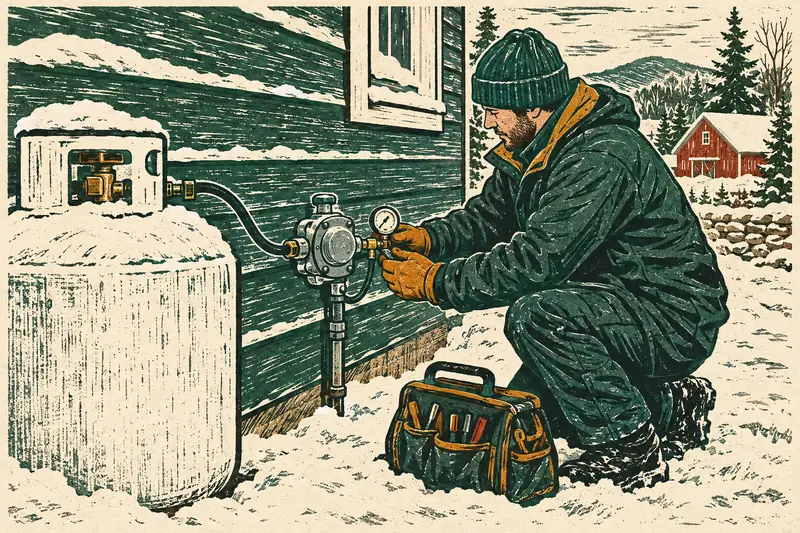
If you smell gas, the run-out can wait
- Get everyone out now. Don't flip switches, use phones or appliances inside, or open the garage door, and don't hunt for the leak.
- From outside and well away, call 911, then your propane supplier. Stay out until responders or the supplier say it's safe.
- Never go to the tank to work its valve during a suspected leak; that's for the supplier or responders.
- A carbon monoxide alarm, or headaches, dizziness or nausea: everyone outside to fresh air, then call 911.
- If you're unsure, stop and call your supplier or a licensed technician.
First tap of the season
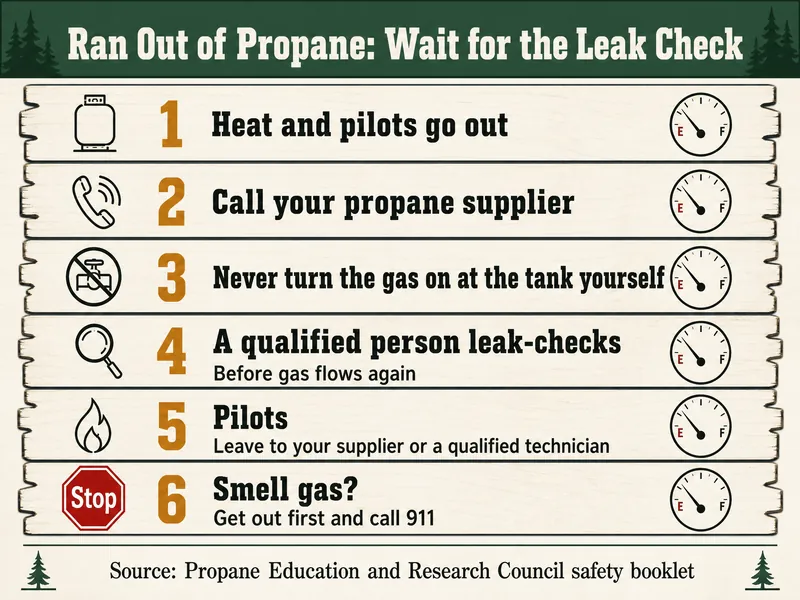
- PERC, the propane industry's safety council, says: "Never turn the gas on at the propane tank yourself" (PERC safety booklet).
- After a run-out, PERC tells you to have your retailer or a qualified professional do a leak check, restore service and, if needed, see to the pilots.
- PERC notes that "safety codes in every state require a 'qualified person' for certain tasks."
- The Maine Attorney General says a customer on an automatic-delivery contract whose company failed to deliver "should not be required to pay any fee" for an emergency delivery.
- The CDC's winter advice for pipes: let taps drip, open cabinet doors under sinks, and never thaw a pipe with a torch.
- New York's HEAP offers emergency benefits to households in danger of running out of fuel (OTDA).
What happens when you run out of propane?
When the tank runs dry, every propane appliance stops: furnace or boiler, water heater, range, and any pilot lights go out. PERC's booklet lists running out of gas as the first reason pilots go out, and its first question for an appliance that quits is simply "You may be out of gas."
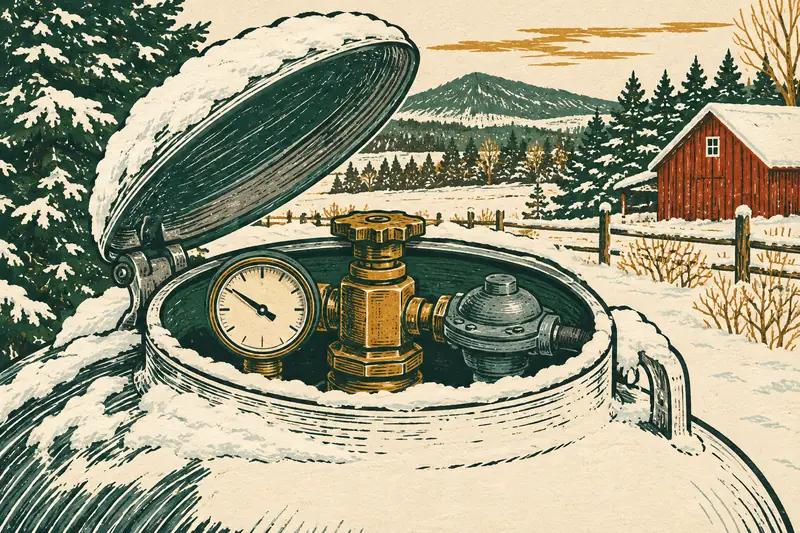
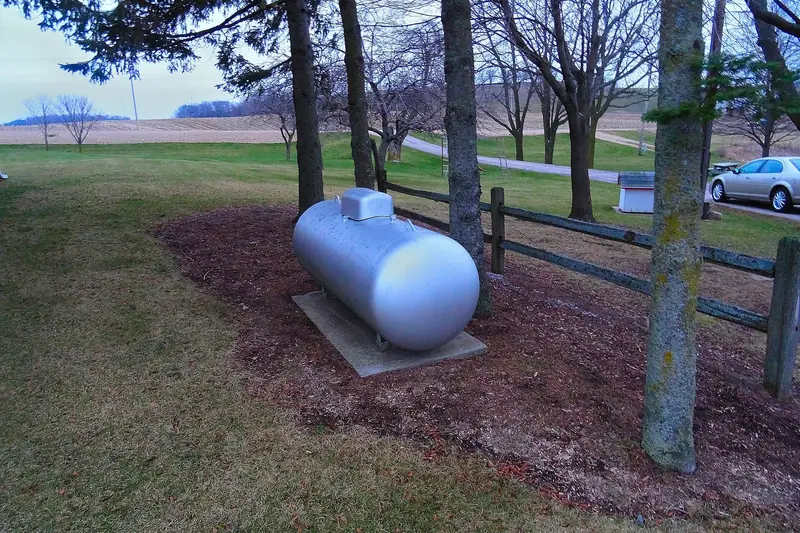
If there's no gas smell, you can check the gauge under the tank's dome lid before you call: lift the lid only to read the dial and leave every valve alone; a reading near zero confirms it. If you smell gas, don't go to the tank at all. The gauge shows percent of the tank's capacity, so 5 means about 5% left, not 5 gallons (how to read a propane tank gauge). Then call your supplier and say plainly that you are out, not just low.
Why does the system need a leak check?
Because restoring gas to a system that went empty is a job the propane industry and safety codes reserve for a qualified person. PERC's wording is direct: "A qualified professional must check the propane system for leaks when turning the gas on."
The reasoning is in the same booklet: improper service "can result in a gas leak, fire, explosion, and serious injury or death," and PERC lists "if you run out of gas or if the gas is shut off" among the times to use a qualified professional. The leak check is the supplier's way of confirming the piping and appliances are tight before gas flows, which is why it sends a trained person, not only a delivery.
In Maine, installing or servicing propane equipment requires a Fuel Board license, with a narrow exception for owner-occupied single-family homes that still must meet the Board's rules (32 M.R.S. § 18102). Vermont requires anyone servicing propane systems to hold a state gas certification. Hire the licensed or certified person either way.
What should you do while you wait?
Stay warm safely and protect the pipes. Turn nothing on at the tank, leave the appliance knobs alone, and keep everyone away from improvised heat that makes carbon monoxide.
- No indoor burning for heat. The CPSC says never use ranges, ovens or clothes dryers to heat your home, and never use camping equipment inside unless it's designed for an enclosed space. PERC adds: never use a grill indoors, and never use an outdoor space heater inside.
- Generators stay outside, never in a garage, basement or porch, at least 20 feet from the house, away from windows, doors and vents, with the exhaust pointed away. Wire one to the house only through a transfer switch installed by a licensed electrician.
- Pipes: the CDC says to let taps drip and open the cabinet doors under kitchen and bathroom sinks. If a pipe freezes, don't thaw it with a torch.
- Access: shovel a path to the tank and clear the area around it so the truck crew can reach it. Brush snow off the regulator and piping with a broom, not a shovel, and never put heat on a tank.
If money is the reason the tank ran low, ask about help today. Maine DOER says a household very low on fuel that can't afford a fill may qualify for an emergency delivery through 2-1-1 or its Community Action Agency (Maine winter heating resources), and New York HEAP has emergency benefits for households in danger of running out.
Why leave the pilots to the supplier?
Because the pilots should only be lit after the leak check, by the person who did it. PERC's run-out checklist puts the three tasks in one sentence for your retailer or a qualified professional: "perform a leak check, restore gas service, and, if needed, light your pilot lights."
Fill Pipe's rule is simpler still: leave pilots to your propane supplier or a qualified technician, every time. PERC warns that "lighting or troubleshooting pilot lights improperly can cause fire and explosion," that you should "never try to let air out of the gas line — you will release gas," and that people should leave appliance knobs and controls alone. NFPA, the fire-code body, likewise says a pilot that keeps going out may signal a safety problem for a fuel gas professional to handle.
| Task | Who does it | Source |
|---|---|---|
| Notice the outage and read the gauge | You | PERC: check the gauge periodically |
| Deliver propane | Your supplier (the tank's owner, if it's leased) | Maine 10 M.R.S. § 1658-A |
| Leak-check the system | Retailer or qualified professional | PERC |
| Restore gas at the tank | Retailer or qualified professional, never the homeowner | PERC |
| Pilots and appliance restart | Retailer or qualified professional | PERC |
How do you avoid running out of propane?
Read the gauge on a schedule and agree on clear delivery terms with your supplier. PERC's advice is two sentences long: "Check the fuel gauge on your propane tank periodically. Discuss delivery options and timing with your propane retailer."
Automatic delivery helps but isn't foolproof. Maine DOER's propane pricing booklet reports that "during the 2025-26 heating season, many auto-fill customers did not receive timely deliveries," and suggests asking for the specific level that triggers a delivery and a direct contact number. The plan choices are laid out in propane delivery and prebuy plans.
Winter access matters as much as the schedule. A truck that can't reach the tank can't fill it, so keep the driveway and tank path plowed or shoveled through the season.
Run-out facts
- 20 feetor more between a running generator and windows, doors and ventsCDC
- 2025-26season when many Maine auto-fill customers missed timely deliveriesMaine DOER
- 3tasks PERC gives your retailer or a qualified professional after a run-out: leak check, restore service, pilotsPERC
What does a run-out cost?
Expect a delivery charge plus a separate service charge for the leak check, and ask both prices when you call; no state survey we read publishes typical amounts. Vermont's Consumer Protection Rule 111 lists a "leak or pressure test" among the charges a propane seller may bill.
Some states limit who pays. The Maine AG says a customer on automatic delivery whose company "failed to deliver" and left them out or low "should not be required to pay any fee or charge for an emergency delivery." Vermont's 9 V.S.A. § 2461b bars fees for propane not actually delivered and minimum-usage fees. If the run-out has you thinking about a different fuel or backup, see heat in a winter power outage and the propane hub.
Scaler's notes: how this page was put together
What this page rests on: PERC's homeowner safety booklet (PRC-101063D), NFPA's 2026 public education messages, CPSC's carbon monoxide safety page, CDC winter storm and carbon monoxide pages, Maine DOER's propane pricing booklet and winter heating resources, the Maine Attorney General's heating fuels page, 32 M.R.S. § 18102, Vermont's Division of Fire Safety and 9 V.S.A. § 2461b, and New York OTDA's HEAP page, read October 2026. We left out NFPA code section numbers and state rule numbers for the leak check because we did not read those texts, plus any fee amounts.
Questions from the woodshed
Can I just have the tank filled and restart the furnace myself?
No. PERC says a qualified professional must check the system for leaks when the gas is restored, and to never turn the gas on at the tank yourself. The driver or a service technician handles the restart.
Do I need to turn off my appliances when the propane runs out?
Leave the knobs and valves alone and tell the supplier which appliances you have. PERC tells people not to turn or play with appliance controls, and the person doing the leak check restarts them.
Will the supplier come at night or on a weekend?
That depends on the company. Ask now, before you need it, whether it offers after-hours deliveries and what it charges for them.
Is it safe to use a space heater while the propane is out?
PERC says never use portable heaters indoors unless they are designed and approved for indoor use, and warns that using an outdoor space heater inside "can be deadly." Fill Pipe doesn't recommend unvented propane or kerosene heaters at all.
Can a run-out damage my pipes?
Water pipes can freeze if the house cools long enough. CDC's winter storm page says to keep a trickle running from taps and let warm air reach pipes under sinks, and never to thaw them with a torch.
Who pays if automatic delivery let me run out in Maine?
The Maine AG says a customer whose automatic-delivery company failed to deliver should not be charged an emergency delivery fee. Keep the contract and delivery records.
More on propane and winter heat

Back to the Fill Pipe home page