Folder · 6 pages
Oil and Propane Tanks, Gauges and Age
Oil and propane tanks hold your winter: a 275-gallon steel oil tank in the cellar, or a propane tank outside read in percent, each with its own gauge, inspection rules and signs of age.
Written by the Fill Pipe desk from state, federal and maker documents · how the pages are made · Updated
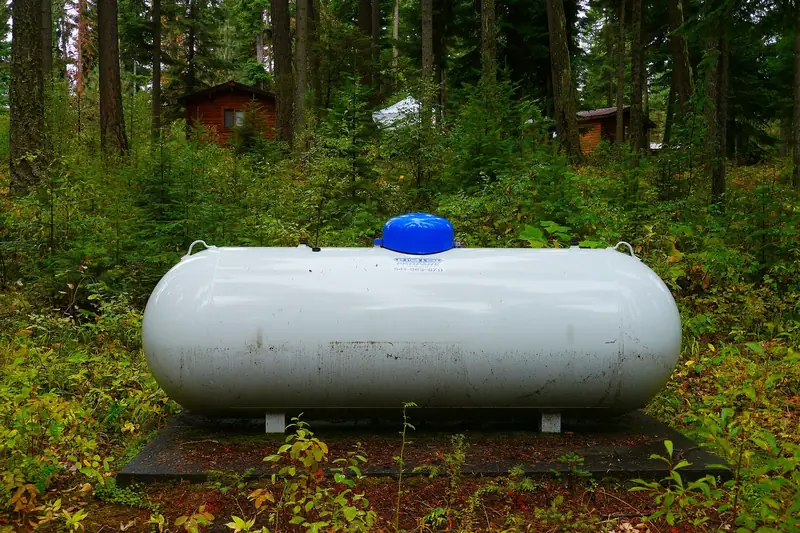
First tap of the season
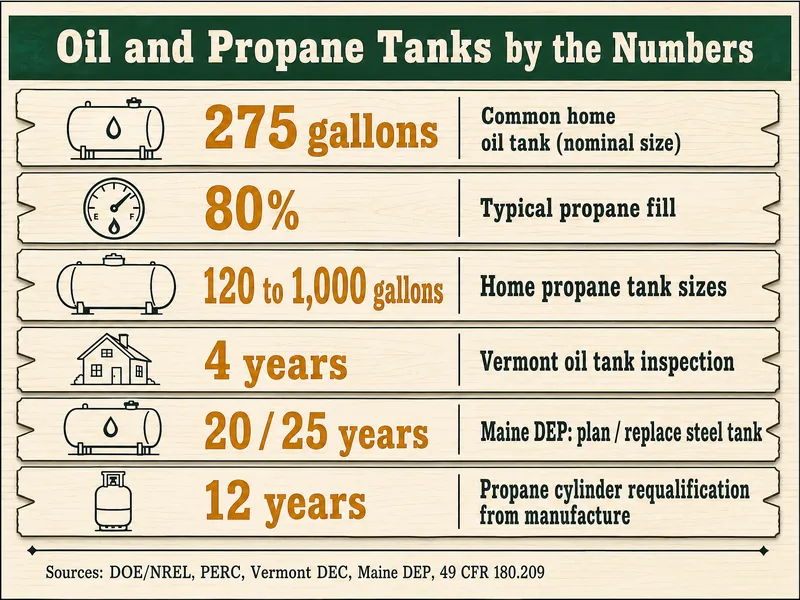
- 275 gallons is the common home heating oil tank, according to the DOE/NREL biodiesel handling manual; that is a nominal size, not a fill figure.
- A propane gauge reads percent of the tank's capacity, and home tanks are typically filled to about 80% to leave room for expansion (PERC).
- Home propane tanks run from 120 to 1,000 gallons of water capacity in PERC's size table, with 250, 320 and 500 in between.
- Maine DEP's age guidance: start planning a new tank at 20 years, and replace a steel one as it nears 25.
- Vermont requires oil tank inspections at least every four years under AST Rules effective August 1, 2024.
- Maine DEP counts more than one spill a day from home heating oil tanks, and names corrosion from the inside out as the leading cause.
Before you read on
- Smell propane inside: get everyone out now. Touch no light switches, phones, flames or appliances, and don't start a car or garage door inside. Don't look for the leak. From outside and well away, call 911, then your propane supplier, and stay out until they say it's safe.
- CO alarm sounding, or headache, dizziness, nausea or confusion: everyone outside to fresh air, call 911 from outside, and don't go back in until responders say so.
- Strong oil smell, smoke or soot from the burner: turn nothing on, leave if smoke fills the space and call 911; otherwise call your oil company's service line.
- Oil pooled under the tank or a fresh wet spot on it: look, don't touch, and call your oil dealer.
- If you're unsure, stop and call your supplier or a licensed technician.
What do oil and propane tanks have in common?
Both are storage you live beside but don't service yourself: the fuel company or a licensed technician fills, inspects and repairs them. Heating oil is a liquid at room temperature, usually in a steel tank in the basement; propane is stored under pressure as a liquid in a tank outdoors or buried, and turns to vapor on its way to the house.
That one difference drives everything else on these pages. An oil tank fails slowly, by rust and weeps, and its worst day is a spill on the cellar floor. A propane tank's worst day is a gas leak, which is why the propane smell steps start with getting out, never with the tank. The Fill Pipe safety section covers both fuels.
How do you read a tank gauge?
A propane gauge reads percent of the tank's capacity; an oil tank gauge reads in gallons or inches, depending on the model. PERC's training material puts it plainly: a gauge reading 30 means 30 percent is left. Since a fill typically stops at about 80%, a fresh tank rarely reads higher, and that is normal.
Oil float gauges come in versions marked in gallons or in inches, according to Scully's catalog, which also says the gauge is "Not intended for use as an overfill prevention device." The propane gauge page turns percent into gallons for each common size, and the 275-gallon tank page covers the float gauge and the fill whistle.
What size tank do homes use?
Most oil-heated homes in this region use a 275-gallon tank, and propane homes use anything from a 120-gallon tank to a 1,000-gallon one. Propane sizes are listed by water capacity in PERC's technical pocket handbook, so a 500-gallon tank holds about 400 gallons of propane at a typical fill.
Your supplier picks the size from your appliances' total Btu load and the coldest weather the tank will see; the propane tank sizes page shows how.
Who inspects the tank?
The company that fills the tank does the inspecting, and in Vermont the law spells out when. Vermont's AST Rules require an oil tank inspection when a new tank is installed, when you switch fuel carriers and at least every four years, by an inspector with NORA or Vermont oilheat credentials (Vermont DEC). New Hampshire's state aboveground tank rules exempt home heating oil tanks, and New York's bulk storage rules leave out home heating tanks under 1,100 gallons.
For propane, the company that owns the tank fills it, and a new supplier will require a safety inspection before its first delivery, according to Maine DOER's propane pricing booklet. The propane tank inspection page lists what gets checked, and the leased or owned tank page covers who owns what.
When does an oil tank need replacing?
There is no single lifespan, but Maine DEP gives two markers: begin planning at 20 years, and replace a steel tank as it approaches 25. Condition matters as much as age. Maine DEP's check-your-tank questions ask whether the tank is leaning, patched or rusty, whether you see weeps or wet spots, and whether the gauge is cracked or stuck.
The oil tank replacement page covers state rules, who may do the work and the help available in each state. If you already see oil, go to the oil tank leak page first.
| Item | Heating oil tank | Propane tank |
|---|---|---|
| Common home sizes | 275 gallons (DOE/NREL) | 120 to 1,000 gallons water capacity (PERC) |
| What the gauge shows | Gallons or inches, by gauge model (Scully) | Percent of capacity (PERC) |
| Typical fill | Driver stops when the vent whistle stops (Scully) | About 80%, leaving room for expansion |
| Who fills it | Any dealer you choose, unless you're on a contract | Only the company that owns the tank, if leased |
| Inspection rule | Vermont: at least every four years | Supplier safety check; cylinders requalified |
| Age guidance | Maine DEP: plan after 20 years, replace steel near 25 | No home-tank lifespan sourced |
Tank numbers worth knowing
- 275gallons, the common home oil tank size (nominal)DOE/NREL
- 80%typical propane fill, leaving room for expansionPERC
- 4 yearslongest gap between Vermont oil tank inspectionsVermont DEC
- 25 yearsage at which Maine DEP says to replace a steel tankMaine DEP
Every page in the tanks folder
 Tanks and gauges: Reading a propane tank gauge
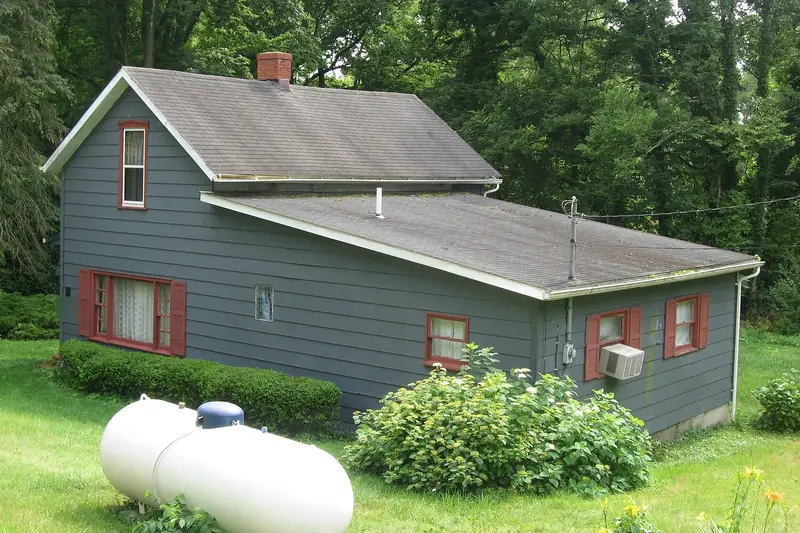 Tanks and gauges: Propane tank sizes for homes
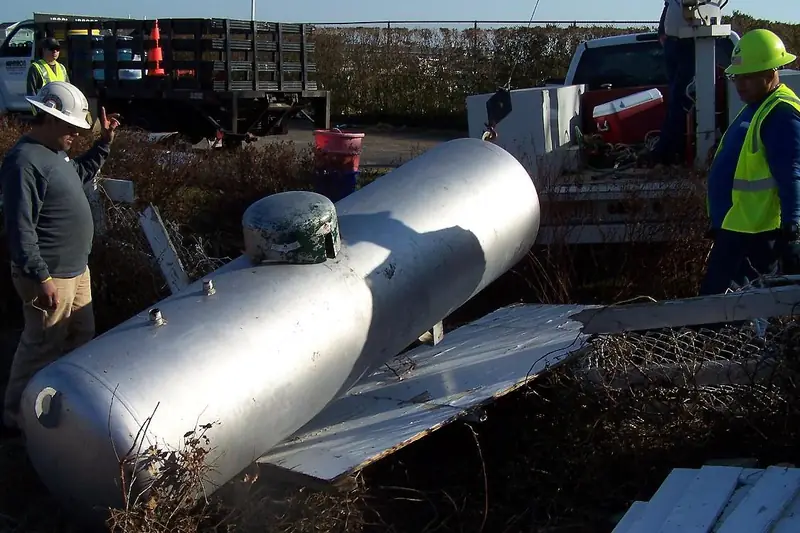 Tanks and gauges: Propane tank inspection
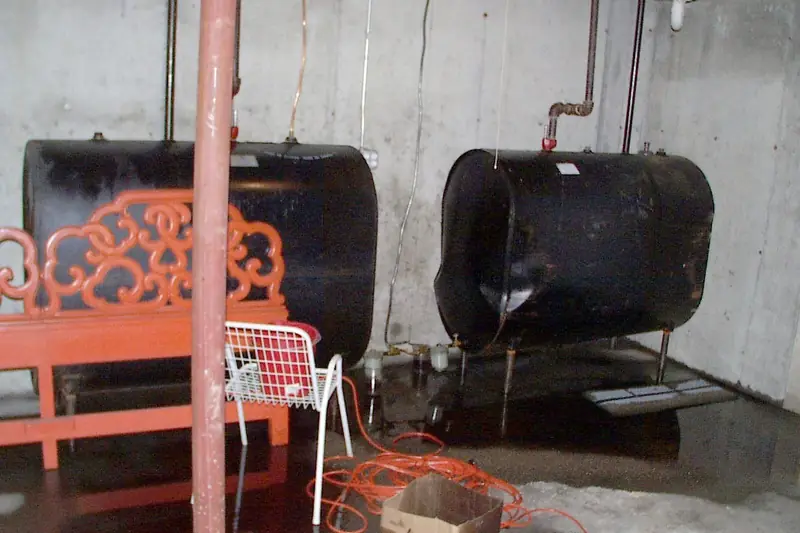 Tanks and gauges: The 275-gallon oil tank
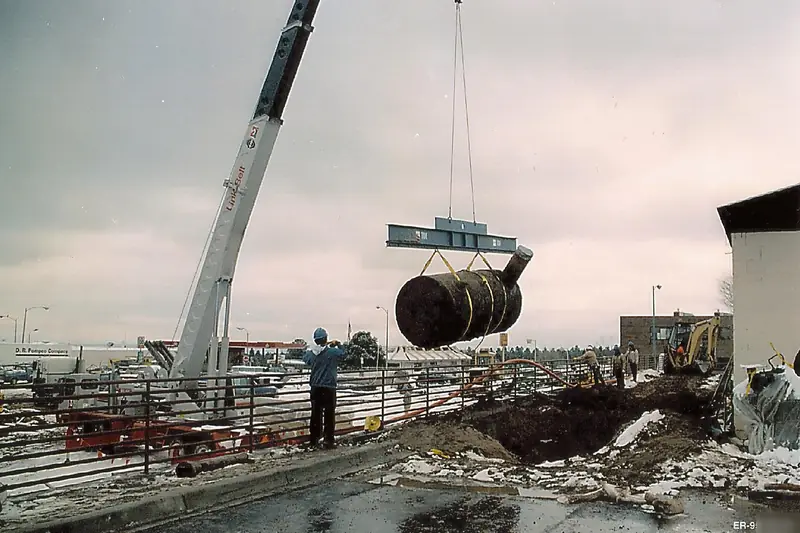 Tanks and gauges: Oil tank replacement
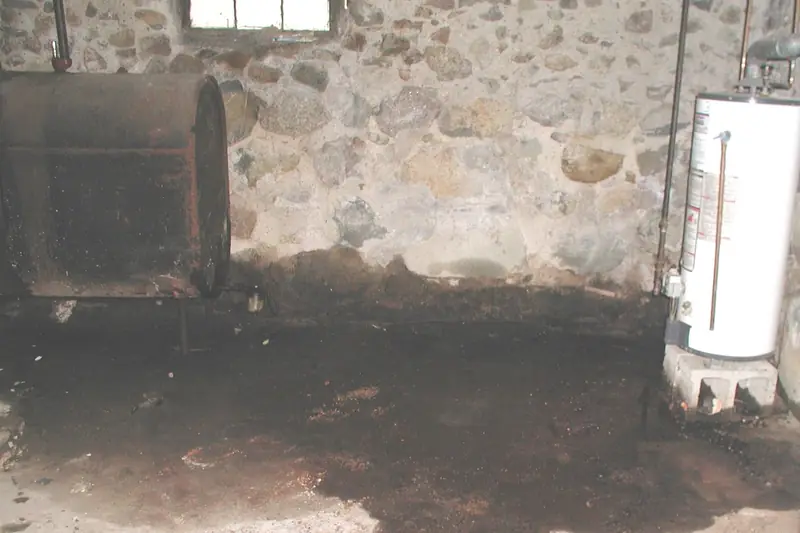 Tanks and gauges: Oil tank leak: signs and first steps
Scaler's notes: how this page was put together
Based on documents read in October 2026: Maine DEP's tank pages, Vermont DEC's heating-tank page and AST Rules, NHDES, 6 NYCRR Part 613, PERC's booklet, lesson and pocket handbook, the DOE/NREL biodiesel manual and Scully's catalog. We left out any single tank lifespan, any usable-gallon figure for a 275-gallon tank and any gallon value for oil gauge marks, because no primary source we read gives one.
Questions from the woodshed
Are oil tanks and propane tanks inspected the same way?
No. In Vermont, oil tanks have a state inspection schedule with red and yellow tags, while propane tanks are checked by the supplier that fills them. New Hampshire exempts home oil tanks from its aboveground tank rules, and New York's bulk storage rules leave out home tanks under 1,100 gallons.
Does a propane tank need replacing at a certain age?
We found no primary source that gives a lifespan for a home propane tank, so we don't print one. Requalifying at 12 years after manufacture, with later checks timed by the test method, is a rule for small DOT cylinders such as grill tanks under 49 CFR 180.209, not for the ASME tank in your yard. Ask your supplier what its safety check covers.
Can I tell how old my oil tank is?
Look for a label or date plate on the tank and ask your oil dealer, who may have installation records. Maine DEP says crimped tank ends are usually a sign the tank may date from 1999 or earlier. If you can't find a date and the tank shows rust or weeps, treat it as old.
Why doesn't my propane gauge ever read 100?
Propane tanks are typically filled to about 80% so the liquid has room to expand on warm days, so 80 is a normal full reading. PERC's training lesson explains the expansion reason for cylinders, and suppliers fill home tanks with the same space left.
Who pays to replace an old oil tank?
Usually the homeowner, but each state has some help: New Hampshire's Safetank program, Maine DEP grants and Community Action Agency replacements, and Vermont DEC assistance for lower-income households. The replacement page lists each program's own terms.
How often does a Vermont oil tank get inspected?
At least every four years under Vermont's aboveground tank rules, in force since August 1, 2024, plus at installation and when you change fuel carriers. A tank with a red tag can't be filled until the problem is fixed. New Hampshire and New York don't set a statewide schedule for home tanks of this size, so ask your dealer what it checks at delivery.
Back to the tank-gauge front page