Leased or Owned Propane Tank
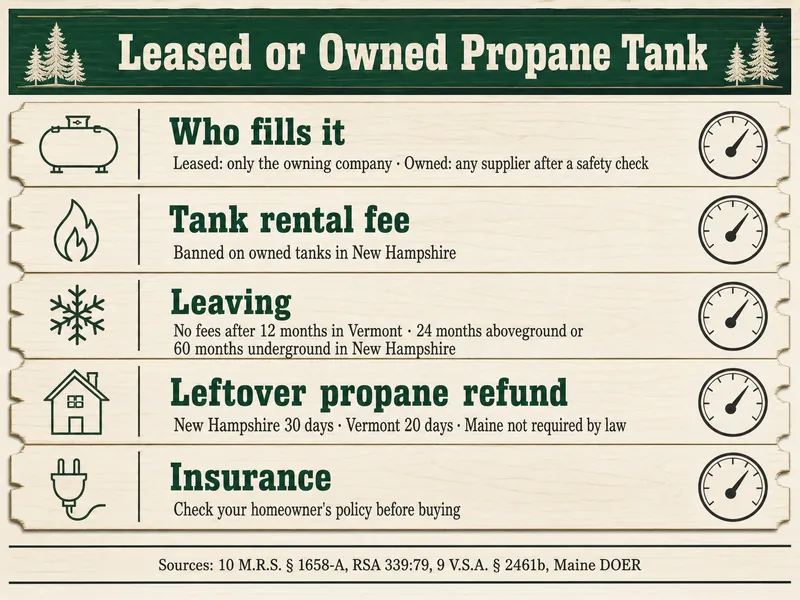
A leased propane tank belongs to the company that fills it, so only that company may refill it, while an owned tank lets you buy from any supplier willing to safety-check it first.
Written by the Fill Pipe desk from state, federal and maker documents · how the pages are made · Updated
First tap of the season
- Maine's 10 M.R.S. § 1658-A bars anyone but the owner, or someone the owner authorizes in writing, from filling a propane container.
- Maine's Attorney General says most residential propane customers don't own their tanks.
- New Hampshire's RSA 339:79 bans rental, lease or minimum-use fees on a tank owned by the customer or another company.
- Vermont's 9 V.S.A. § 2461b says a seller can't refuse to fill a customer-owned tank once you show proof of ownership and it passes a safety check under NFPA 54 and NFPA 58.
- Common home tank sizes run 120, 250, 320, 500 and 1,000 gallons of water capacity in PERC's technical table.
- Maine DOER tells anyone thinking of buying a tank to confirm their homeowner's insurance covers it.
What does a leased propane tank mean?
A leased propane tank is owned by the propane company and set on your property under its service contract, and that ownership decides who fills it. In Maine the rule is written into law: "No person except the owner, or a person authorized in writing by the owner to do so, may fill or refill a liquefied petroleum gas container," and "owner" means whoever holds title.
The Maine Attorney General spells out what that means at the kitchen table: if you don't own the tank, "the propane dealer may require you to receive all deliveries of propane from them" (Maine AG). Maine DOER adds that most other states have similar laws.
A lease usually comes with charges an owner doesn't pay. Maine DOER's propane pricing booklet lists four fees to ask about: annual tank rental, an annual leak detection and safety inspection, delivery, and tank removal and pump-out if you switch.
How do you tell if your tank is leased?
Your paperwork tells you: the service contract, your bills and, if you bought the house, the closing documents. An annual tank rental line on a bill points to a company-owned tank, and the company that fills it can confirm in writing who holds title.
Don't assume the tank came with the house. A tank owned by a propane company stays that company's property when a house changes hands, so ask the seller and the supplier before closing. If nobody can show you a bill of sale for the tank, treat it as leased until the company says otherwise.
What does owning the tank change?
Owning the tank lets you shop for propane, because Maine's AG says owners are "free to shop for the best price and service." In return you take on the tank: its care, its insurance and the safety check a new supplier will want before the first fill.
New Hampshire law protects owners from paying rent twice. RSA 339:79 says "No dealer may charge a rental, lease, or minimum use fee for a heating fuel tank that is owned by another company or the consumer." In Vermont, 9 V.S.A. § 2461b requires a seller to deliver to a customer-owned tank once you show proof of ownership and the seller has done a safety check under NFPA 54 and NFPA 58.
Ownership doesn't change price tiers. Maine DOER says dealers price in tiers and "smaller volume customers pay more per gallon," so a small user with an owned tank still pays the small-user rate.
What do state laws say about leased tanks?
New Hampshire and Vermont protect leased-tank customers when they leave; Maine leaves most of it to the contract, and we found no New York statute. Here is what each statute says, in short.
- New Hampshire (RSA 339:79, as amended effective August 31, 2026): the dealer has 30 calendar days from your notice, or as soon as weather and access allow, to remove its tank or transfer it to another dealer. Within 30 days of disconnection it must refund leftover propane at the price of your most recent delivery. No termination, removal or pump-out fees once an aboveground tank has been on the premises 24 months, or an underground tank 60 months (actual excavation costs excepted). New or higher fees need 60 days' written notice.
- Vermont (9 V.S.A. § 2461b): after the tank has been on the premises 12 months, no fee to remove it, pump it out or end service. The refund for leftover propane is due within 20 days, and removal within 20 days, or 30 for an underground tank. Vermont's Consumer Protection Rule 111 adds a standard disclosure form for new customers and 60 days' notice of fee changes (Vermont AG).
- Maine: dealers "generally reimburse customers for any propane remaining in a tank," Maine DOER says, "although state law does not require them to do so." Read the contract.
- New York: we found no statute on tank removal or refunds; ask for the terms in writing before you sign.
| Question | Leased tank | Owned tank |
|---|---|---|
| Who may fill it | Only the owning company in Maine (10 M.R.S. § 1658-A) | Any supplier after a safety check (Vermont law requires the check) |
| Tank rental fee | Often charged yearly (Maine DOER fee list) | Banned in New Hampshire (RSA 339:79 VII) |
| Upkeep and inspection | The owning company | Your responsibility; a supplier checks before filling |
| Insurance | Company's tank | Confirm your homeowner's policy covers it (Maine DOER) |
| Leaving the supplier | Company removes its tank; state rules on fees and refunds | You keep the tank and change suppliers |
Is buying your own propane tank worth it?
Buying your own propane tank pays only if the freedom to shop saves more than the tank, its setup and its upkeep cost, and no state source we read puts a number on that. Get a price for the tank and a written quote from at least two suppliers, including their safety-check fee, before deciding.
Three facts frame the choice. Maine DOER says to verify that your homeowner's insurance would cover an owned tank. New Hampshire requires dealers to offer the option to buy a leased underground tank during the term of service, at a price set in the existing contract or at fair market value. And tank placement, including distances from windows, doors and property lines, is set by the fire code (NFPA 58) and local rules, so a supplier or licensed installer sets any new tank.
If you're comparing sizes, see propane tank sizes for homes; PERC's technical table lists a 500-gallon tank at about 38 inches across and 10 feet long, noting sizes vary by maker.
Leased and owned tanks by the numbers
- 24 monthsbefore NH bans removal fees on an aboveground tankRSA 339:79
- 60 monthsbefore NH bans removal fees on an underground tankRSA 339:79
- 12 monthsbefore Vermont bans termination fees9 V.S.A. § 2461b
- 20 daysVermont deadline to refund leftover propane9 V.S.A. § 2461b
Who inspects an owned propane tank?
Your supplier or another qualified professional does, not you. PERC's safety booklet says only a qualified professional should service "tanks, cylinders, pipes, and their components," and Vermont's Division of Fire Safety requires anyone inspecting, installing or servicing propane systems to be state-certified. Maine law requires a Fuel Board license to install or service propane equipment, with a narrow exception for owner-occupied single-family homes that must still meet the Board's rules (32 M.R.S. § 18102); hire a licensed technician.
Expect a check whenever a new supplier takes over: Maine DOER says the new company "will require a safety inspection" and charge for it. PERC also suggests asking your retailer for a visit to learn what's under the tank's dome, including the shut-off valves and regulator, so you know the layout before there's ever a problem. More on what that visit covers is in propane tank inspection.
Signs to stop and call
- You smell propane: get everyone out, touch no switches or phones, and call 911, then your supplier, from well away. See propane smell in the house.
- Never go to the tank to work its valves during a suspected leak; the supplier or responders do that.
- A dented tank, bent piping or a tank shifted by snow or a storm: stay clear and call the tank's owner.
- If you're unsure, stop and call your supplier or a licensed technician.
Scaler's notes: how this page was put together
This page is based on Maine's 10 M.R.S. § 1658-A and 32 M.R.S. § 18102, the Maine Attorney General's heating fuels page, Maine DOER's 2026-2027 propane pricing booklet, New Hampshire RSA 339:79 (as amended effective August 31, 2026), Vermont's 9 V.S.A. § 2461b and the Vermont AG's CP 111 summary, Vermont Division of Fire Safety, and PERC's safety and technical booklets, each read during October 2026. Tank prices, clearance distances and any New York rule are left out because we found no primary source for them.
Questions from the woodshed
Can a different company fill my leased tank in Maine?
No. Maine law allows only the owner, or a person the owner authorizes in writing, to fill a propane container. Switching means the new company sets its own tank or you buy one.
Does a leased tank come with the house when it's sold?
No. A company-owned tank stays the company's property. Buyers should ask the seller and the supplier who holds title and what the service contract says before closing.
Can a New Hampshire dealer charge rent on a customer-owned tank?
No. RSA 339:79 bars rental, lease and minimum-use fees on a heating fuel tank owned by the consumer or another company.
Can I buy the leased underground tank in New Hampshire?
Yes. Dealers must offer the option to buy a leased underground propane tank during the term of service, at a price in the existing written contract or, without one, at fair market value.
Will a Vermont supplier fill a customer-owned tank?
A seller can't refuse if you show proof of ownership and it has done a safety check under NFPA 54 and NFPA 58. Expect that check, and its fee, before the first delivery.
Does an owned tank need requalifying every 12 years?
The 12-year requalification rule PERC describes applies to portable cylinders like grill tanks. Home tanks are a different category, so ask your supplier what checks your tank needs.
Is a leased tank safer than an owned one?
Neither is safer by ownership alone. Either way, a qualified professional should check the system, and PERC says homeowners should never install, modify or repair a propane system themselves.
More on propane tanks