Oil Tank Replacement
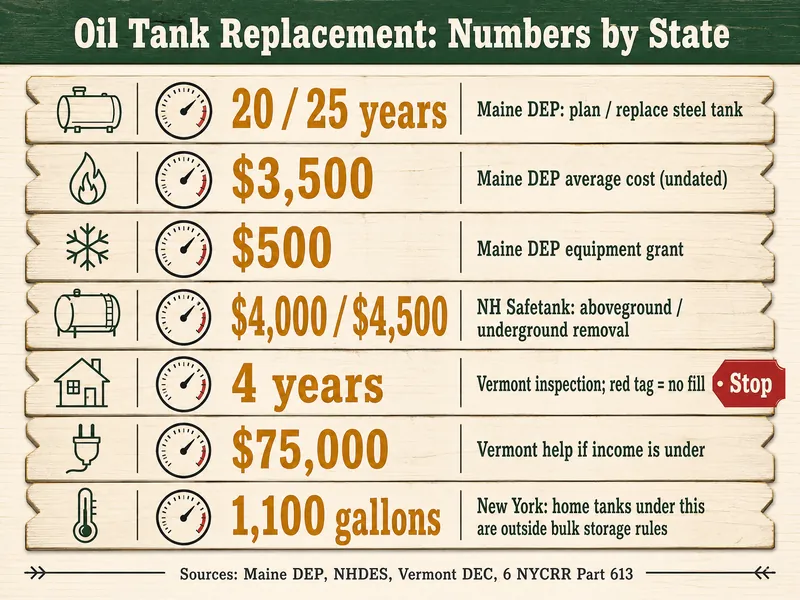
Oil tank replacement is worth planning once a steel tank passes 20 years: Maine DEP suggests planning then and replacing a steel tank as it approaches 25, sooner if it shows rust or weeps.
Written by the Fill Pipe desk from state, federal and maker documents · how the pages are made · Updated
Who’s behind the links: Fill Pipe is run by the people who own Plumbing Supply and More, SoftPro Water Systems and Quality Water Treatment, and it has a working tie to Central Plumbing & HVAC. No business pays to appear here. Figures and safety steps on this page come from state energy offices and environmental agencies, federal agencies (EIA, IRS, CPSC, CDC), the propane and heating-oil industries' own safety programs, and equipment makers' manuals, read in October 2026. Fill Pipe sells no fuel and services no equipment. Owners and outbound links
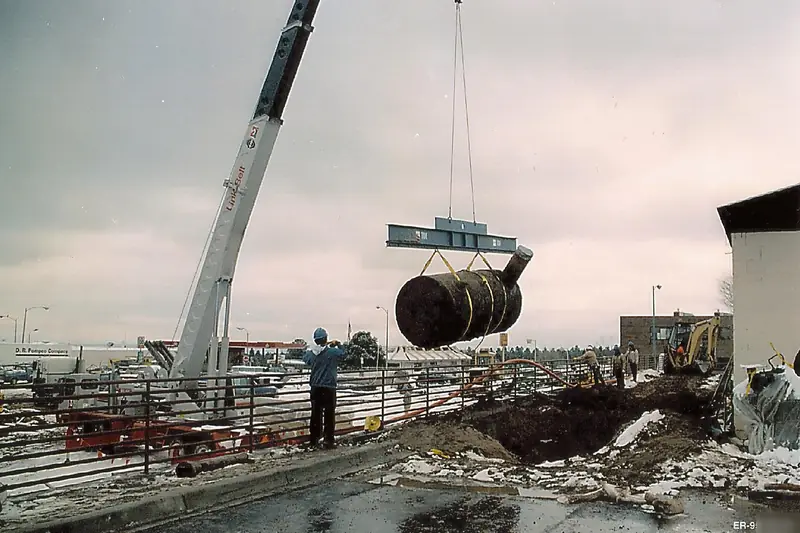
First tap of the season
- Start planning at 20 years and replace a steel tank close to 25, Maine DEP advises; rust or weeps move that date up.
- Vermont's AST Rules require an inspection at least every four years, and a red-tagged tank can't receive deliveries until the problem is fixed.
- New Hampshire's aboveground tank rules don't reach home heating oil tanks (NHDES), but its Safetank program can reimburse up to $4,000 to upgrade or replace an aboveground tank.
- In New York, a home heating tank under 1,100 gallons falls outside the state's petroleum bulk storage definition of a facility.
- Maine DEP's undated FAQ puts the average tank replacement at $3,500.
- Vermont DEC offers removal and replacement help to households that made less than $75,000 the previous tax year.
Stop and call
- Oil on the floor, under the tank or around the filter: look, don't touch, and call your oil dealer. In Vermont or New York, the spill may also need a report; see the oil tank leak page.
- A strong oil smell, smoke or soot puffing from the burner: turn nothing on, leave if smoke fills the space and call 911; otherwise call your oil company's service line.
- A tank that leans, sways or sits on a crumbling base: don't push it or try to level it; call your oil dealer.
- Never move, cut, empty or disconnect a tank yourself.
- If you're unsure, stop and call your supplier or a licensed technician.
When does an oil tank need replacement?
An oil tank needs replacement when it shows damage or nears the end of its safe service, and age is the first clue: DEP's suggestion is to begin planning at the 20-year mark and to swap out a steel tank as it gets close to 25. There is no single lifespan. Granby, a tank maker, warranties its tanks from 3 to 30 years depending on the model, and says installation quality, use and indoor or outdoor location all affect how long one lasts.
Condition can move the date up. Maine DEP's spill-prevention page says to replace a tank approaching 25 years old or one that meets its "high risk" criteria, which include rust, weeps, wet spots, patches, excessive dents and a leaning or unstable tank. Ultrasonic thickness testing can help judge a tank under 20 years old, DEP says, but past 20 it may no longer be effective, and it's time to consider replacement or another heat source.
The cause is mostly hidden. DEP says corrosion, usually from the inside out, is the leading cause of spills from home oil tanks in Maine, as water, sludge and sediment settle at the bottom and eat the steel. If you are weighing a heat pump at the same time, the switching section covers what changes when oil becomes backup or goes away.
What do state rules require?
State rules differ more than most homeowners expect, so check your own state before planning the job.
- Vermont: the AST Rules require an inspection when a new tank is installed and right after its first fill, when you switch fuel carriers and at least every four years. Tanks failing set items get a red tag and can't be filled; residential tanks installed before August 1, 2024 may get a yellow tag instead, allowing limited deliveries until May 1. Existing tanks must meet new foundation and fill-and-vent-pipe standards by July 1, 2030.
- New Hampshire: NHDES says home heating oil tanks are exempt from the state's aboveground tank rules. Its Safetank reimbursement requires the work to meet NFPA 31 and NHDES best-practice standards for heating oil tanks (2008 edition).
- New York: under 6 NYCRR Part 613, a home heating oil tank used on the premises with less than 1,100 gallons of capacity is not a petroleum bulk storage "facility." We could not read DEC's homeowner page or any county rules, so ask your town and county before work starts.
- Maine: Maine DEP's tank pages set out its replacement guidance, and its checklist asks whether your system complies with the Maine Fuel Board's standards.
| State | Home tank rule | Help with replacement |
|---|---|---|
| Maine | DEP: start planning at 20 years, swap steel close to 25; Fuel Board standards | Up to $500 DEP equipment grant; income-eligible replacement through Community Action Agencies |
| New Hampshire | State aboveground tank rules don't cover home heating tanks | Safetank: up to $4,000 aboveground, up to $4,500 to remove an underground tank |
| Vermont | Inspection at least every four years; red and yellow tags | Assistance for households under $75,000 income |
| New York | Under 1,100 gallons: not a bulk storage facility | None found in a state source we could read |
Who can replace an oil tank?
A licensed oil heat technician or tank installer should replace it, and in some states the law says so. In Maine, installing or servicing oil equipment takes a Maine Fuel Board license; the statute's carve-out for owners working on their own single-family home is narrow and still holds that work to Board standards, so use a licensed technician. Granby's own position is blunt: "All tanks must be installed by licensed installers."
In Vermont, the inspections that follow a new installation must be done by someone holding NORA Gold, Silver or Bronze certification, a Vermont Oilheat Certificate of Fitness or a NORA-approved tank seminar certificate. In New Hampshire, Safetank money depends on meeting NFPA 31. New York turned up no statewide licensing rule in our reading, so pick a qualified company that carries insurance, and know that some cities and counties license tank work.
What does oil tank replacement cost?
Cost depends on the tank, the site and what else needs fixing, so get written quotes; the one published figure we found is Maine DEP's, which says "the average cost of a tank replacement is $3,500" on an undated FAQ page. Treat that as a rough reference, not a price.
Help exists in three of the four states. New Hampshire's Safetank program "can reimburse up to $4,000 to upgrade or remove and replace an aboveground home heating oil storage tank and up to $4,500 to remove an underground home heating oil tank." Maine DEP's FAQ describes up to $500 through its Home Heating Oil Equipment Replacement Project, with no income limits, and full replacements for income-eligible homeowners through Community Action Agencies, using the same income guidelines as LIHEAP. Vermont DEC says households that made less than $75,000 in the previous tax year may qualify for removal or replacement help.
What happens on replacement day?
On replacement day the installer sets the new tank, connects the fill, vent and oil line, and the old tank comes out; your job is to have the paperwork straight beforehand. Ask in writing who removes the old tank and any oil left in it, where they go, whether the oil line needs replacing, and whether the price includes the permit or inspection your town or state requires.
In Vermont, the new tank is inspected after installation and right after its first fill, and the inspector must give you a copy of the checklist within five business days. Vermont DEC says that if contamination is found or suspected while an old tank is being removed, the Agency's spill response program must be contacted; the oil tank leak page covers reporting in each state. Maine DEP also says an oil line buried in the basement floor without a sleeve must be replaced, so ask about yours.
The fittings, valves and filter parts in that listing are what an installer will specify for the tank's connections; it shows what they look like, not something to fit yourself.
Single-wall or double-wall?
Both are allowed for new tanks, and the choice is about how the tank resists the inside-out corrosion Maine DEP describes. Vermont's AST Rules list five acceptable designs for new tanks: a single-wall steel tank of at least 12-gauge built to NFPA 31; a double-bottom steel tank with end-cover protection and monitoring of the space between the bottoms; a double-wall tank with a plastic inner wall and metal outer wall; a double-wall non-metallic tank; or a single-wall non-metallic tank for indoor use only.
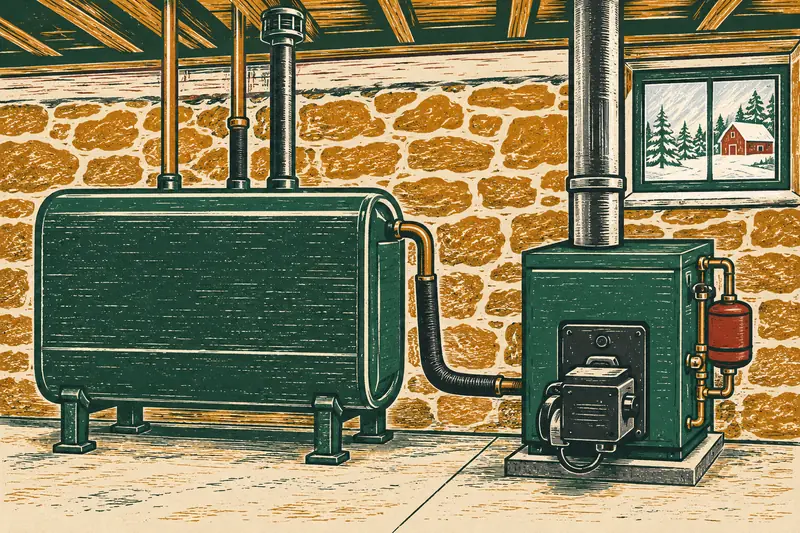
The DOE/NREL biodiesel handling manual says newer plastic tanks with steel outer enclosures are being installed alongside the traditional 275-gallon steel tank. Granby sells double-wall and double-bottom models, with warranty terms that differ by model. Since Maine DEP says corrosion mostly starts inside at the bottom, ask each installer how its design handles water and sludge settling there, and compare warranties in writing. The 275-gallon tank page explains the whistle, gauge and base any new tank should have.
Replacement numbers
- 25 yearsthe age by which a steel tank should be swapped out, per Maine DEPMaine DEP
- $4,000most NH Safetank reimburses for an aboveground tankNHDES
- 4 yearslongest gap between Vermont tank inspectionsVermont DEC
- 1,100 gallonsNew York's cutoff below which a home tank isn't a bulk storage facility6 NYCRR 613-1.3
Questions for the installer
Which design are you quoting, and why?
Single-wall steel, double-bottom or double-wall, and the warranty term for each in writing.
Who takes away the old tank and the oil in it?
Get the disposal plan and any cost on the quote.
Does the oil line need replacing?
Maine DEP says an unsleeved line buried in the floor must be replaced.
Which inspection or permit applies here?
In Vermont, the new-install and first-fill inspections; elsewhere, ask about town and county rules.
Scaler's notes: how this page was put together
We read Maine DEP's spill-prevention, checklist and FAQ pages, the 2024 Vermont AST Rules and DEC's page on heating tanks, NHDES's fuel storage and Safetank pages, 6 NYCRR Part 613, Maine's licensing law, Granby's residential tank page and the DOE/NREL biodiesel manual in October 2026. We left out any universal tank lifespan, any current market price and any New York county rule, because we couldn't source them from a primary page. We don't rank tank designs or makers.
Questions from the woodshed
Can I replace an oil tank myself?
Hire a licensed installer. Maine requires a Fuel Board license for this work outside a narrow owner-occupant exception, Granby says all tanks must be installed by licensed installers, and Vermont's post-install inspections need credentialed inspectors.
Is a 30-year-old oil tank safe?
By Maine DEP's guidance it is past the point to replace a steel tank, which DEP puts at approaching 25 years. Get it looked at by your oil dealer or a licensed technician and plan the replacement now.
Does Vermont's red tag mean my tank must be replaced?
Not always. A red tag stops deliveries until the listed problem is corrected, which might be a missing whistle or an unsleeved line rather than the tank itself. Ask the inspector what fix clears it.
Will my insurance pay for a new oil tank?
We found no primary source on what homeowner policies cover, so ask your insurer directly and get the answer in writing before you rely on it.
Should the tank be replaced when switching to a heat pump?
It depends on whether you keep oil as backup. Efficiency Maine's whole-home rebate allows the old system only as emergency backup, while Efficiency Vermont's ducted program generally keeps fossil backup, so check your program first.
Does New York require removing an old basement tank?
We found no New York state rule for home tanks under 1,100 gallons, and we couldn't read DEC's homeowner page or county rules. Ask your town, county and oil dealer what applies where you live.
Keep reading