Oil Furnace and Boiler Service, Once a Year
Oil furnace cleaning and boiler service belong on the calendar once a year, at the start of each heating season, and the visit should end with a new nozzle, a fresh filter and a combustion test.
Written by the Fill Pipe desk from state, federal and maker documents · how the pages are made · Updated
Who’s behind the links: Fill Pipe is run by the people who own Plumbing Supply and More, SoftPro Water Systems and Quality Water Treatment, and it has a working tie to Central Plumbing & HVAC. No business pays to appear here. Figures and safety steps on this page come from state energy offices and environmental agencies, federal agencies (EIA, IRS, CPSC, CDC), the propane and heating-oil industries' own safety programs, and equipment makers' manuals, read in October 2026. Fill Pipe sells no fuel and services no equipment. Owners and outbound links
First tap of the season
- Beckett's burner manual says a qualified service technician must service the burner annually, and more often in dusty or adverse environments.
- Weil-McLain's WGO Series 4 schedule says call for annual service at the beginning of each heating season.
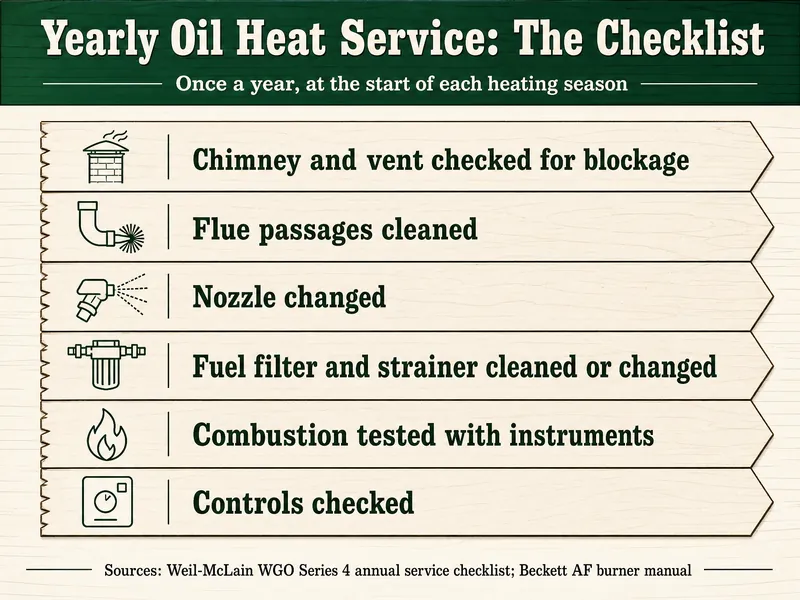
- The Weil-McLain checklist includes changing the nozzle, cleaning or changing the fuel filter and strainer, cleaning flue ways and verifying combustion with test equipment.
- CPSC, CDC and NFPA all advise yearly inspection of fuel-burning heating equipment, including the chimney and flue, to cut carbon monoxide risk.
- In Maine, servicing an oil burner takes a Fuel Board license under 32 M.R.S. § 18102, apart from a narrow exception for owners in their own single-family home.
- Weil-McLain links tankless-coil hot water that turns lukewarm to mineral deposits inside the coil, which a technician delimes or replaces.
Don't wait for the tune-up if
- You smell strong oil or exhaust, or see smoke or soot around the burner, the boiler or the flue pipe.
- The pipe between the boiler and the chimney is loose or damaged: Weil-McLain says turn off the boiler switch and call. If the CO alarm is sounding or anyone feels ill, skip the switch and get everyone outside first.
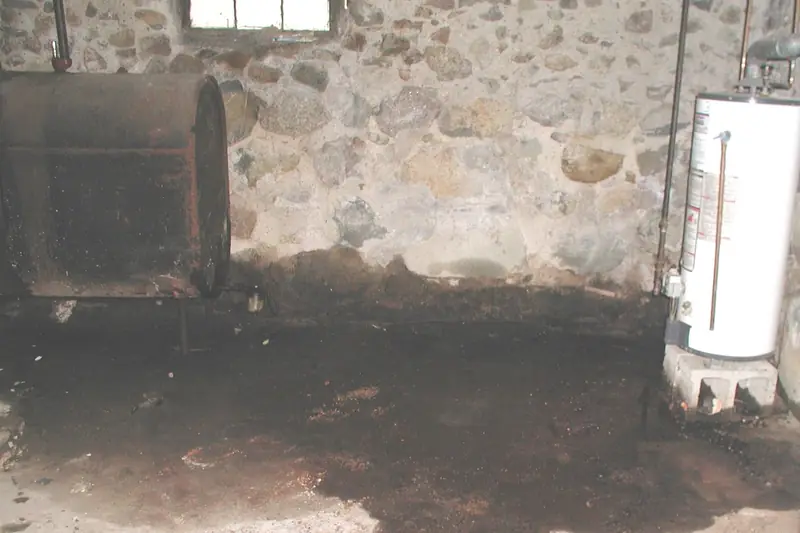
- You find oil leaking from the piping or around the burner, or water leaking from the boiler.
- The CO alarm sounds or anyone has a headache, dizziness or nausea: everyone outside, then call 911.
- If you're unsure, stop and call your supplier or a licensed technician.
Why does oil heat need yearly service?
Oil heat needs yearly service because the burner, nozzle, filter and flue all foul with use, and only test instruments show whether it's burning cleanly. Beckett's AF/AFG burner manual says "a qualified service technician must service this burner annually," and that adjusting it takes "skillful use of combustion test instruments."
Safety agencies say the same for every fuel-burning heater. The CPSC carbon monoxide page advises having the heating system professionally inspected and serviced every year, with the chimney and flue checked for blockages, corrosion and loose or broken connections. CDC and NFPA give the same yearly interval.
Riello adds a practical reason in its 40 Series owner instructions: the oil line filter cartridge should be replaced every year by your technician, and annual service keeps the burner at its best efficiency.
What does an oil furnace cleaning include?
An oil furnace cleaning is mostly burner work plus the flue: new nozzle and filter, cleaned and checked parts, and a combustion test at the end. Beckett's maintenance list, which applies to the burner whether it sits on a furnace or a boiler, runs like this:
- Clean and inspect the electrodes and check their settings; replace cracked or rounded ones.
- Inspect the combustion head and air tube and remove any carbon.
- Clean the blower wheel, air inlet and burner housing of lint and dirt.
- Check the pump pressure and cutoff, the primary control's safety lockout timing and the ignition.
- Inspect the vent system and chimney for soot or other restriction, and clean the flue passages and flue pipe.
- Check burner performance with test instruments and record the combustion results.
Ask for that record. Beckett calls it good practice to keep a record of the service and the combustion test results, and next year's technician can compare them. On a furnace, the appliance itself also gets cleaned according to its maker's instructions.
What does oil boiler service add?
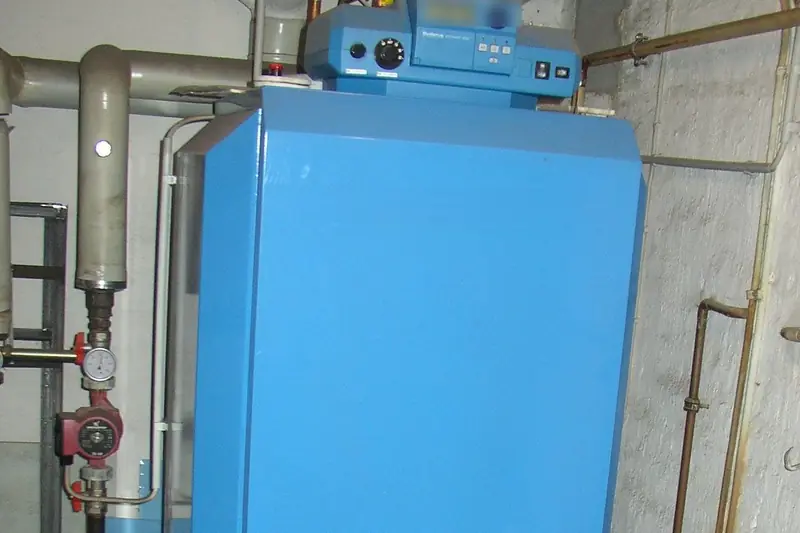
Oil boiler service adds the water side: leaks, the relief valve, the circulator and, if you have one, the tankless hot-water coil. Weil-McLain's WGO Series 4 manual prints an annual service call checklist in order:
- Boiler area free of combustible materials, gasoline and other flammable liquids.
- Combustion and ventilation air unobstructed.
- Breeching, chimney or vent checked for blockage and damage.
- Boiler flue ways cleaned.
- Relief valve and circulator serviced.
- Boiler and piping checked for leaks, including the tankless heater plate.
- Burner inspected and adjusted: nozzle changed, electrodes checked, blower cleaned, fuel filter and strainer cleaned or changed.
- Boiler confirmed full of water.
- Combustion settings verified with combustion test equipment.
- All boiler controls checked.
Weil-McLain's Series 3 manual gives one target for that last test on its boilers: 13% CO2 or less with a smoke level of zero. Your technician uses the number for your model.
| Item | Oil furnace visit | Oil boiler visit | Source |
|---|---|---|---|
| Nozzle changed | Yes | Yes | Weil-McLain WGO checklist; Riello commercial manual |
| Fuel filter and strainer | Cleaned or changed | Cleaned or changed | Weil-McLain WGO; Riello 40 Series |
| Chimney, vent and flue passages | Inspected and cleaned | Inspected and cleaned | Beckett AF/AFG; Weil-McLain WGO |
| Relief valve and circulator | Not applicable | Serviced | Weil-McLain WGO |
| Tankless heater plate | Not applicable | Checked for leaks | Weil-McLain WGO |
| Combustion test with instruments | Yes, results recorded | Yes | Beckett AF/AFG; Weil-McLain WGO |
When is the best time to book it?
The best time to book is before the heat runs hard: Weil-McLain's maintenance schedule lists "beginning each heating season" as the time to call for annual service. Booking before the season starts gives the company time to fit you in and order any part your burner needs.
Beckett notes that a burner in a dusty or harsh space may need service more often than once a year. A burner that needed its reset pressed, smelled of oil or left soot shouldn't wait for the yearly visit; see the oil burner reset button page for when a stop means a call.
Between visits, Weil-McLain's owner schedule is simple: daily, keep the boiler area clear of anything that burns; weekly, look for blocked air openings, a loose pipe to the chimney, oil leaks around the burner and water leaks at the boiler. NFPA sets a 3-foot circle around the furnace that should stay clear of anything combustible.
Service numbers from the manuals
- 1professional service visit a year, minimumBeckett
- 13%CO2 or less, with zero smoke, as Weil-McLain's Series 3 settingWeil-McLain
- 3 feetclearance for things that can burn around a furnaceNFPA
- 7 grainsboiler-water hardness above which Weil-McLain says consult a water treatment companyWeil-McLain
Who is allowed to do the work?
A licensed or qualified oil heat technician does the work, and the rules on licenses differ by state. Maine law, 32 M.R.S. § 18102, says anyone who installs or services oil, propane or natural gas burning equipment must hold a Fuel Board license; owner-occupied single-family homes have a narrow exception, and that work must still meet the Board's rules. Hire a licensed technician.
Fill Pipe found no statewide oil-burner technician license in New York; use a qualified, insured service company, since some cities and counties license this work. We didn't read New Hampshire's licensing rules, so ask any New Hampshire company what credentials its technicians hold. In Vermont, oil tank inspections must be done by an inspector with NORA or Vermont Oilheat credentials under the state's tank rules.
Questions for the service company
What's on your annual checklist?
Ask whether it includes the nozzle, filter and strainer, flue cleaning, and a combustion test with a printed or written result.
Who will do the work?
In Maine, ask for the technician's Fuel Board license; elsewhere, ask about training and certification, such as NORA.
What does the visit cost, and what's extra?
Ask whether parts beyond the nozzle and filter are billed separately, before the visit, not after.
Will you check the tank and lines?
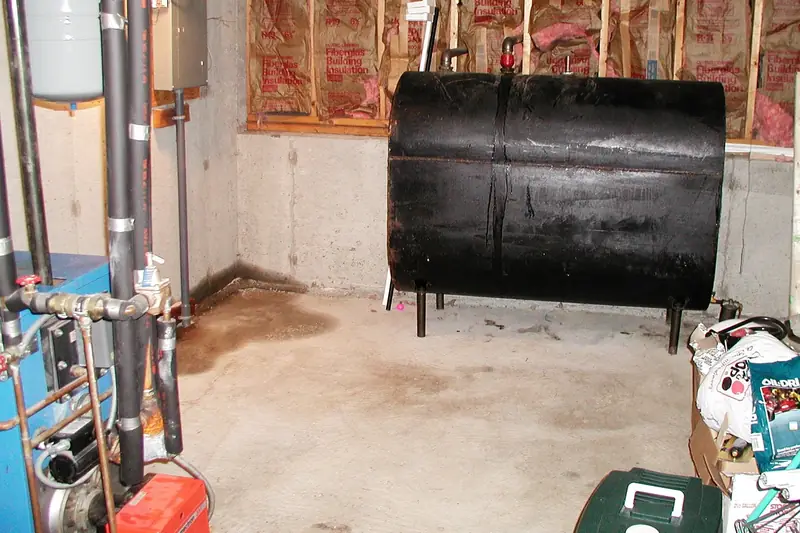
Ask the technician to look over the tank, its legs and the oil line on the same trip.
Central Plumbing & HVAC, a heating company in Bucks and Montgomery counties, Pennsylvania, outside this region, is one example of how a heating company's service page lays out what it does; look for the same on any northern company you call.
How does hard water affect a boiler's hot water?
Hard water leaves mineral scale inside a boiler's tankless coil, and the hot water at your taps goes lukewarm or turns cold mid-shower. Weil-McLain's troubleshooting table lists exactly that symptom and its cause, "mineral deposits insulate internal waterways of heater," and the fix: "have qualified service technician delime or replace coil."
The USGS Water Science School explains why: when hard water is heated, solid deposits of calcium carbonate form, and that scale can shorten equipment life and raise the cost of heating water. USGS classes water at 121 to 180 mg/L as calcium carbonate as hard, and above 180 as very hard. A water test is what tells you whether hardness is a likely cause in your house.
The boiler maker's instructions come first: the technician delimes or replaces the coil, and Weil-McLain separately sets limits on the boiler's own water. Where a water test shows hard water, a softener on the incoming supply is one option for the coil and the rest of the plumbing. One example is the SoftPro ECO softener, also sold through Quality Water Treatment (Quality Water Treatment, run by the same people as Fill Pipe). Parts for the burner itself are the technician's call; the oil burner parts listing (Plumbing Supply and More, run by the same people as Fill Pipe) shows what those look like.
Scaler's notes: how this page was put together
This page is based on Beckett's AF/AFG burner manual, Weil-McLain's WGO Series 4 and Series 3 boiler manuals, Riello's 40 Series owner instructions, the CPSC carbon monoxide page, CDC and NFPA home safety messages, Maine's Fuel Board statute (32 M.R.S. ch. 139), Vermont's aboveground tank rules and the USGS hardness page, all read October 2026. Each manual covers particular models, so any setting named here is for the model stated. Left out: service prices, which no primary source lists, homeowner nozzle or filter changes, and any claim about fuel savings from a tune-up, which we couldn't source.
Questions from the woodshed
How long does an oil furnace cleaning take?
None of the manuals we read gives a time, and it depends on the appliance and what the technician finds. Ask the company when you book, and leave room in the day for a parts run.
Can you change the oil filter or nozzle yourself?
Fill Pipe doesn't recommend it. Riello says the filter cartridge is replaced by your service technician and warns owners not to tamper with anything under the burner cover, and in Maine servicing oil burning equipment needs a Fuel Board license outside a narrow owner exception.
Do you need service if the burner seems fine?
Yes. Beckett, Weil-McLain, CPSC and CDC all say yearly, and the combustion test can show a problem, such as smoke or poor draft, that you can't see from the basement.
What should the technician leave behind?
A record of what was done and the combustion test results, which Beckett calls good practice. Keep it with the boiler manual for next year.
Does a boiler that only heats hot water in summer still need service?
Yes. A boiler with a tankless coil keeps firing all summer, and Weil-McLain's end-of-season list says the daily and weekly checks still apply when the boiler keeps operating.
Should the chimney be checked during oil boiler service?
Yes. Weil-McLain's checklist and CPSC both include the chimney or vent, looking for blockage, damage and loose connections.
Is there anything to do with the CO alarm at service time?
Test it and check its date. Replace it by the date on the alarm or when it gives its end-of-life signal (often 7–10 years; CDC suggests every 5 years if you don't know). More on the carbon monoxide page.
Keep reading