Storing Propane and Heating Oil Safely
Storing propane safely means cylinders live outdoors, never in a basement, garage or shed; the big tank and the oil tank are set and serviced by your supplier, and your job is clear snow, clear space and a watchful eye.
Written by the Fill Pipe desk from state, federal and maker documents · how the pages are made · Updated
Who’s behind the links: Fill Pipe is run by the people who own Plumbing Supply and More, SoftPro Water Systems and Quality Water Treatment, and it has a working tie to Central Plumbing & HVAC. No business pays to appear here. Figures and safety steps on this page come from state energy offices and environmental agencies, federal agencies (EIA, IRS, CPSC, CDC), the propane and heating-oil industries' own safety programs, and equipment makers' manuals, read in October 2026. Fill Pipe sells no fuel and services no equipment. Owners and outbound links
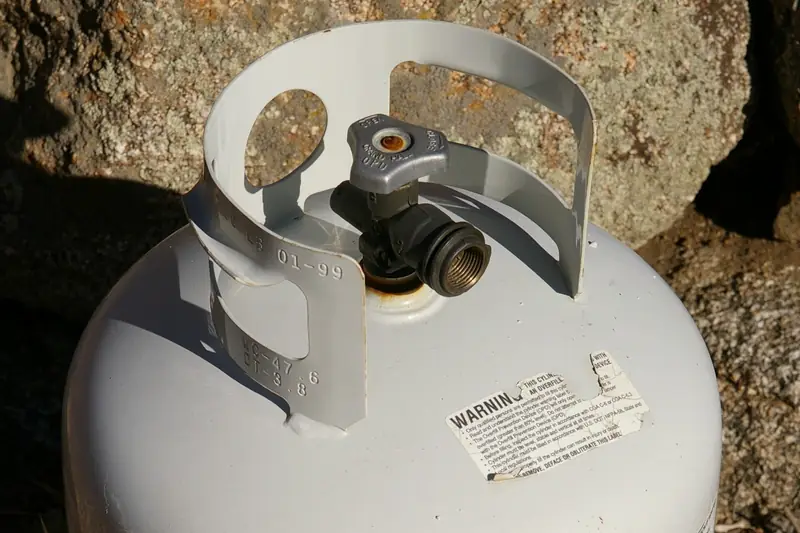
First tap of the season
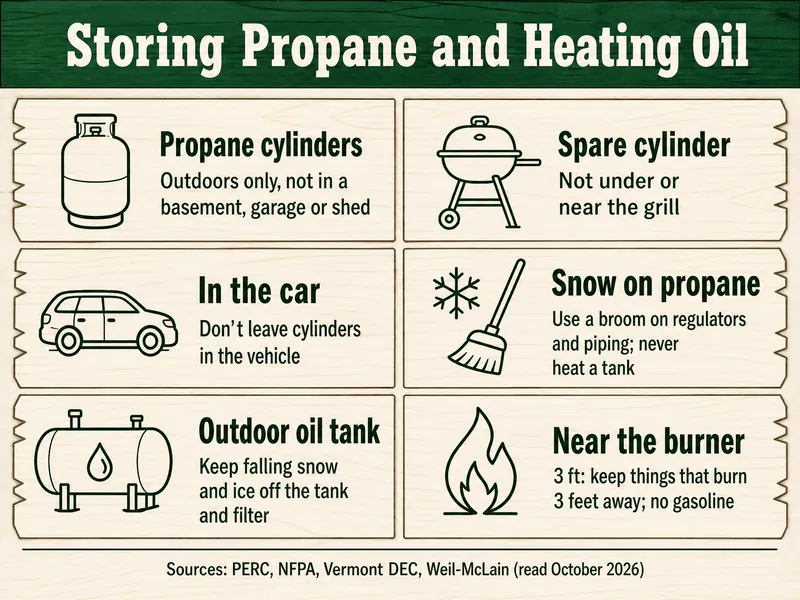
- PERC's propane safety booklet says never to use or store cylinders in a basement, garage, shed or tent, and that even an "empty" one may hold enough propane to be hazardous.
- PERC caps a closed car at four 20-pound cylinders and 90 pounds of propane in total.
- A propane cylinder's first requalification comes 12 years after it was made, and later ones follow a schedule set by the test method (49 CFR 180.209).
- NFPA says to keep things that can burn at least 3 feet from the furnace and never to bring gasoline indoors.
- Vermont's homeowner tank checklist asks whether snow or ice can fall on the oil tank or filter, or block its vent.
- Kerosene cost $6.99 a gallon against $6.04 for No. 2 oil in Maine DOER's October 19, 2026 survey.
How should you store propane at home?
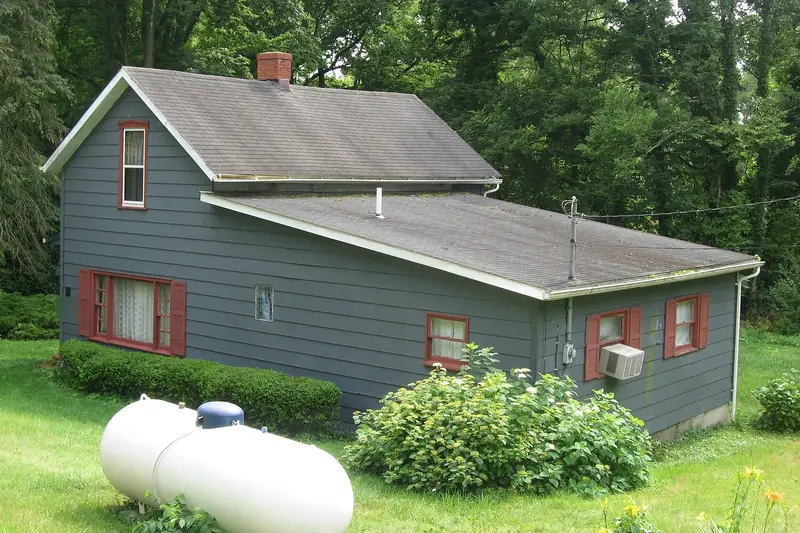
Your propane supplier stores it for you, in a tank they place and fill. Tank placement and the distances from windows, doors, vents and property lines are set by the fire code (NFPA 58) and local rules, and the supplier sets the tank to meet them. Home propane tanks usually get about 80% of their capacity at a fill, which leaves space for the liquid to swell on warm days; PERC explains that reason for cylinders.
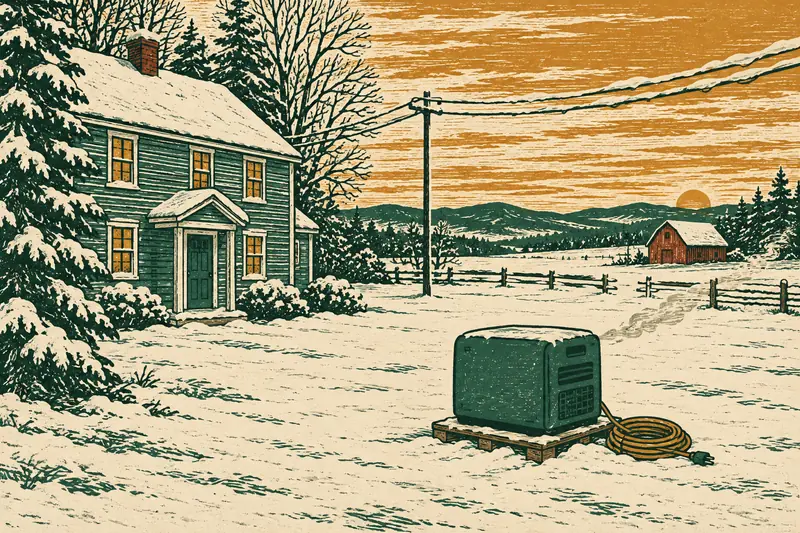
Your part is access and snow: PERC asks you to clear the walkway and tank area so delivery people can reach the tank, and to keep heavy snow and ice off propane piping, regulators and meters, using a broom rather than a shovel. In extreme cold, PERC says never to warm a tank or cylinder with an outside heat source.
If the tank is leased, the owner fills it; Maine law says no one but the owner, or someone the owner authorizes in writing, may fill a propane container. The propane tank sizes page explains the common tanks, and propane tank inspection covers what the supplier checks.
Why do cylinders stay outdoors?
Propane is heavier than air, so a leak indoors collects low and waits for a spark. NFPA says vapors leaked indoors "can be easily ignited by pilot lights or electrical equipment, causing an explosion," and that propane tanks belong outside buildings and garages. PERC puts it in capitals: keep cylinders outside, and never use or store them in an enclosed area such as a basement, garage, shed or tent.
That holds for the grill cylinder in winter too. If the grill goes into the garage or shed for the season, NFPA says the cylinder stays outside. PERC adds that a spare cylinder not hooked to anything shouldn't sit under or near the grill or another propane appliance.
Cars are no place for storage either. PERC says not to leave cylinders inside a vehicle or trunk, and in a closed vehicle to carry no more than four 20-pound cylinders and 90 pounds of propane. Under federal rules a cylinder's first requalification is due 12 years after it's made, with later ones on a schedule that varies by test; PERC says a cylinder past its date can't be refilled until it's inspected, and that cylinders must have an overfill prevention device.
Smell gas near a cylinder or grill? Don't handle it; move people away and call 911 from a distance, as the propane smell page explains.
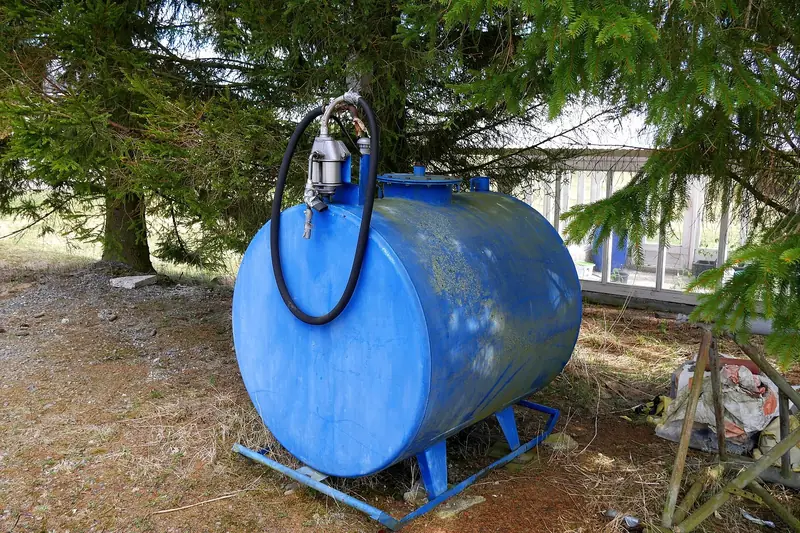
How do you protect an oil tank from snow and ice?
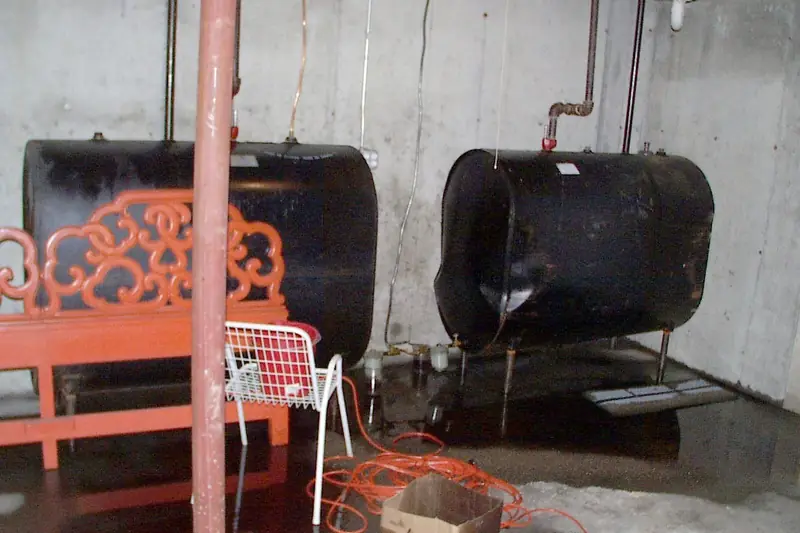
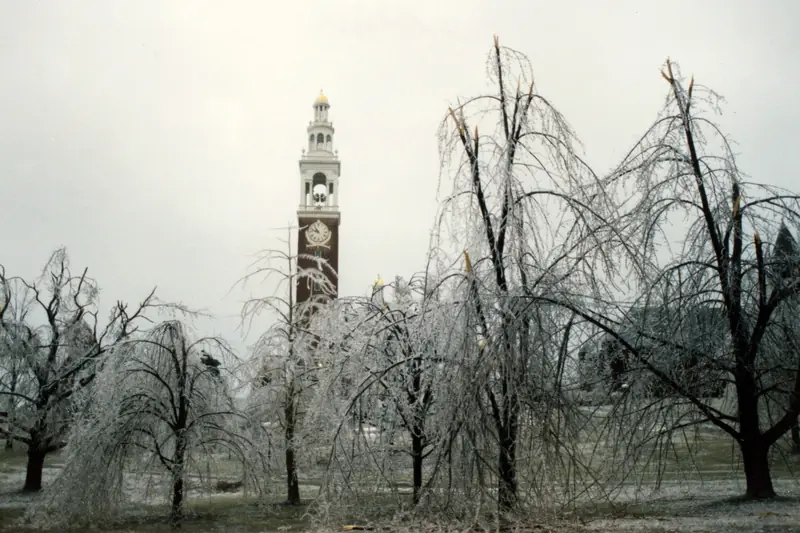
Keep falling snow and ice off the tank, its filter and its vent, and call your oil technician when you can't. Vermont's homeowner self-inspection checklist asks three winter questions: can snow or ice fall on the tank or filter, is the tank's vent clogged by ice or snow, and is the overfill whistle blocked or silent during a fill? A yes to any of them means a call to your licensed oil heat technician.
Maine DEP asks the same and notes that a filter protector can help, since falling ice and snow damage unprotected filters.
New outdoor tanks in Vermont must be protected from snow and ice. The AST Rules list placements such as the gable end of a building, away from the building, or under a shelter with a roof. A vent cap that's cracked, missing or packed with ice is the technician's to replace; the card below shows what that part looks like.
Is kerosene different from heating oil?
Yes. Kerosene is a lighter fuel with a much lower cloud point, which is why some dealers deliver it to outdoor tanks. EIA's glossary calls kerosene a light petroleum distillate with properties similar to No. 1 fuel oil, while No. 2 is the usual home heating oil. ASTM's heating oil standard says the No. 1 grades suit places "where storage conditions require low pour point fuel."
The cold-weather difference shows up in cloud point, the temperature where wax starts to form. The DOE/NREL handling manual gives a cloud-point range of −31°F to 23°F for No. 2-type diesel fuels and −40°F to −60°F for No. 1 diesel (kerosene). The same manual notes that mixtures of No. 1 and No. 2 are common in cold weather. Ask your dealer what goes into an outdoor tank in January.
Kerosene costs more per gallon and carries a little less heat, as the table shows, and New York's bioheat blend law doesn't apply to it. The heating oil hub covers delivery and pricing.
| Measure | No. 2 heating oil | Kerosene (No. 1 type) | Source |
|---|---|---|---|
| Cloud point range | −31°F to 23°F (No. 2-type diesel) | −40°F to −60°F | DOE/NREL |
| Heat per gallon | 138,500 Btu | 135,000 Btu | NH DOE |
| Maine price, Oct. 19, 2026 | $6.04 | $6.99 | Maine DOER |
| NH price, Oct. 26, 2026 | $6.04 | $6.91 | NH DOE |
| New York bioheat law | Applies | Doesn't apply | ECL § 19-0327 |
What should never be stored near the burner?
Nothing that burns, and no gasoline anywhere in the house. NFPA says to keep things that can burn at least 3 feet from the furnace and never to bring gasoline indoors, even in small amounts. Weil-McLain's daily owner check asks that the boiler area be free of combustible materials, gasoline and other flammable vapors and liquids, and Riello's owner sheet says not to store combustible or flammable material near the heating appliance.
PERC adds that vapors from cleaning fluids, paint thinners and gasoline can be ignited by propane appliances. Paint cans, solvents, cardboard, kindling and the mower's gas can all live elsewhere.
What should you leave to the supplier?
Anything on the fuel side: fills, valves, moving or connecting tanks and cylinders, leak checks, inspections, pilots and tank placement. PERC says only a qualified professional has the training to install, service, maintain and repair propane appliances.
State rules back this up in different ways. In Vermont, oil tanks must be inspected at least every four years by a credentialed inspector, and anyone servicing propane systems must be state-certified. Maine law requires a Fuel Board license to install or service oil and propane equipment (owner-occupied single-family homes have a narrow exception, and that work must still meet the Board's rules); hire a licensed technician. New Hampshire exempts home heating oil tanks from its state AST rules, and Fill Pipe found no New York state license rule; some of its cities and counties license the work, so hire a qualified company that carries insurance. The 275-gallon oil tank page covers the most common indoor tank.
Stop and call
- You smell propane near a tank, cylinder or grill: move everyone away and call 911, then your supplier, from a distance.
- Oil is weeping, dripping or pooling at the tank, filter or lines.
- Snow or ice has hit or buried the tank, filter, regulator or vent and you can't clear it with a broom.
- The overfill whistle was silent during a delivery.
- A cylinder is dented, rusted or past its requalification date.
- If you're unsure, stop and call your supplier or a licensed technician.
Board feet: the numbers
- 4most 20-pound cylinders PERC allows in a closed vehiclePERC
- 90 lbmost propane by weight in a closed vehiclePERC
- 3 ftclear space NFPA asks for around a furnaceNFPA
- 12 yearsage at which a cylinder first needs requalifyingeCFR, 49 CFR 180.209
Scaler's notes: how this page was put together
This page draws on PERC's propane booklet (2025) and storage lesson, NFPA's 2026 safety messages, 49 CFR 180.209, Vermont's tank checklist and AST Rules, Maine DEP's tank checklist, NH DES, EIA, ASTM D396, DOE/NREL, the Maine DOER and NH DOE price surveys, Weil-McLain and Riello owner instructions, and the statutes named, all read in October 2026. Left out: propane tank clearance distances, a usable or fill figure for oil tanks, a temperature at which oil gels, and any step that handles a tank, cylinder or valve.
Questions from the woodshed
Can I keep a 20-pound propane cylinder in an unheated shed?
No. PERC lists sheds with basements, garages and tents as enclosed areas where cylinders should never be used or stored. Keep it outdoors, away from heat sources and not under the grill.
Should I switch my outdoor oil tank to kerosene?
Ask your dealer. Kerosene's cloud point is far lower than No. 2's, per DOE/NREL, but it costs more per gallon and carries a little less heat. Fill Pipe found no rule in these four states that requires it.
Where should gas for the snowblower be kept?
Outside the house: NFPA says never to bring gasoline indoors, even in small quantities, and Weil-McLain wants the boiler area free of gasoline and flammable vapors. Keep it in a detached building, away from the house and from propane cylinders.
How do I know if my propane cylinder is out of date?
Cylinders are stamped with a date when they're made. Federal rules call for the first requalification at 12 years, with later dates set by the test used, and PERC says an overdue cylinder can't be refilled. The cylinder exchange or refill location can read the stamp for you.
Can I warm a propane cylinder that won't flow in the cold?
No. PERC says never to warm a tank or cylinder with an outside heat source, in any weather. Wait for a warmer day, or let the exchange or refill location handle a replacement, and keep cylinders outdoors and upright.
Is it safe to keep heating oil cans in the basement for emergencies?
Fill and top-up decisions belong to your dealer, and spare fuel cans don't belong near the burner. Keep gasoline and other flammables away from the boiler, furnace and any propane appliance, and if you run short, call the dealer rather than pouring fuel into the tank yourself.
More on tanks and safety