Reading a Propane Tank Gauge
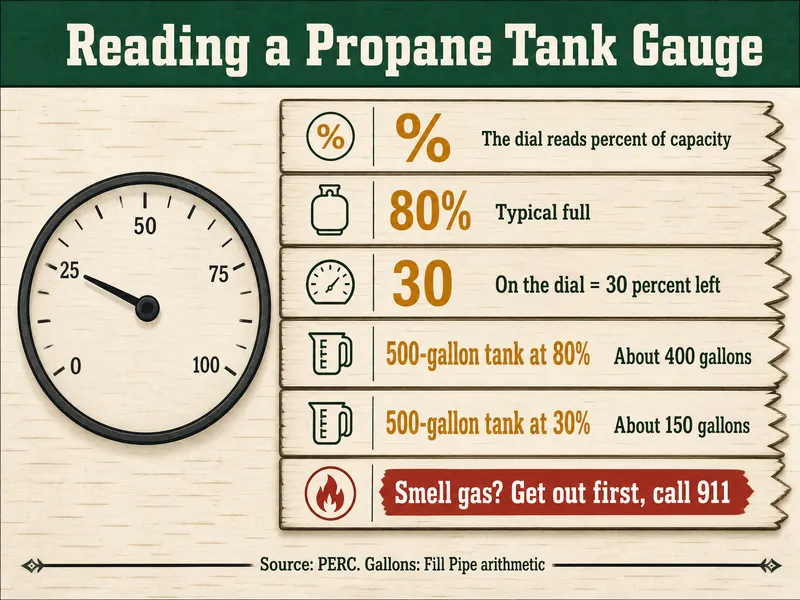
A propane tank gauge reads percent of the tank's capacity, not gallons, so a dial at 30 on a 500-gallon tank means about 150 gallons left.
Written by the Fill Pipe desk from state, federal and maker documents · how the pages are made · Updated
First tap of the season
- The dial shows percent: PERC's training lesson says a gauge reading 30 means 30 percent of the propane is left.
- A fresh fill typically reads about 80, because tanks are filled to about 80% to leave room for the liquid to expand (PERC).
- Gallons left = gauge percent × the tank's water capacity; a 500-gallon tank at 40 holds about 200 gallons.
- PERC lists home tanks of 120, 250, 320, 500 and 1,000 gallons water capacity.
- In Vermont, CP 111 caps the minimum delivery a supplier can require at 225 gallons for a 500-gallon tank when a reasonable payment plan is offered.
- Colder weather and a lower liquid level both cut how much vapor a tank can supply (PERC pocket handbook).
Stop and call instead of reading on
- Smell propane inside: get everyone out now. Touch no light switches, phones, flames or appliances, and don't start a car or garage door inside. Don't look for the leak. From outside and well away, call 911, then your propane supplier, and stay out until they say it's safe.
- Gauge at zero or appliances dead: don't turn anything on at the tank. A qualified person must leak-check the system before the gas goes back on (PERC).
- Hissing near the tank, or the gauge dropping much faster than your usage: call your supplier.
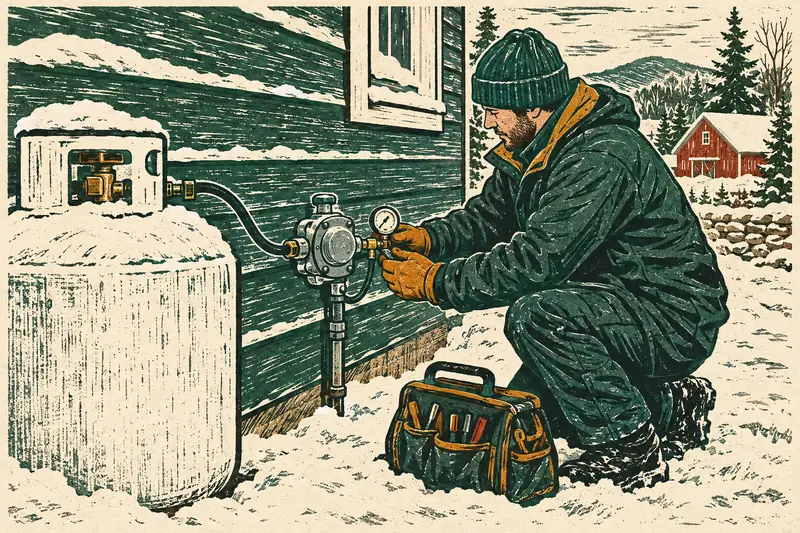
- Snow piled on the regulator or piping: clear it with a broom, never a shovel, and never heat the tank.
- If you're unsure, stop and call your supplier or a licensed technician.
How do you read a propane tank gauge?
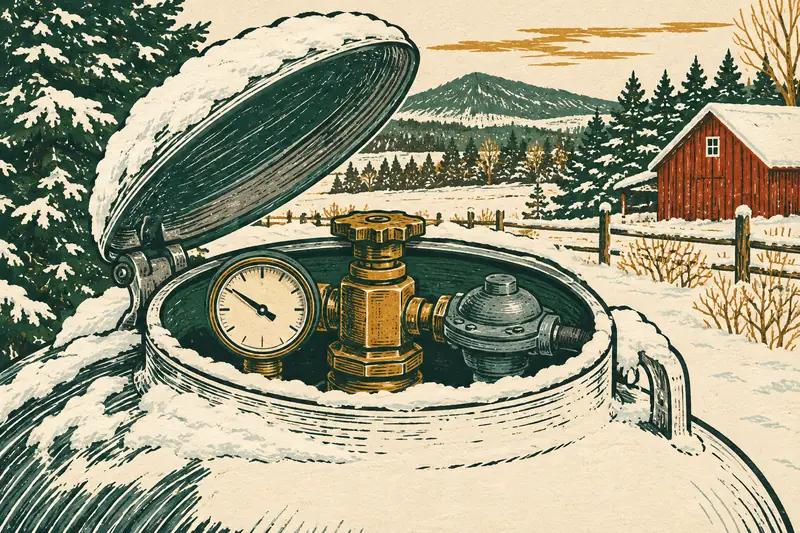
You read a propane tank gauge as a percentage: the number under the needle is how full the tank is, from 0 to 100. The dial sits under the hinged dome lid on top of most home tanks, next to the fill valve and regulator. Lift the lid only to read the dial and leave every valve and fitting alone.
PERC's lesson on storing propane includes a quiz question on exactly this point: a gauge reading 30 means 30 percent is left. The PERC safety booklet tells homeowners to check the gauge periodically and talk over delivery timing with the retailer. If you've never had the parts under the dome explained, PERC suggests asking your retailer for a visit to point out the shut-off valves, regulator and relief valve on a calm day, not during a problem.
Why does a full tank read about 80 percent?
A full propane tank reads about 80 because that is as far as it is filled: the space above the liquid gives propane room to expand when it warms. PERC's lesson says cylinders "should only be filled to 80 percent of the tank's capacity," because filling to less than 100 allows for liquid expansion on hot days. Suppliers leave the same headroom in the tank in your yard.
So a reading of 80 after a delivery is a full tank, not a short fill. A reading in the low 70s right after a fill is worth a question to the driver or the office, with your delivery ticket in hand.
How do you turn percent into gallons?
Multiply the gauge percent by the tank's water capacity, the size stamped on the tank's nameplate or written on your lease. A 500-gallon tank at 40 percent holds about 200 gallons; a 250-gallon tank at 40 percent holds about 100. PERC's technical pocket handbook lists the common home sizes as 120, 250, 320, 500 and 1,000 gallons of water capacity.
| Tank (water capacity) | At 80% (typical full) | At 40% | At 30% | At 20% |
|---|---|---|---|---|
| 120-gallon tank | 96 gal | 48 gal | 36 gal | 24 gal |
| 250-gallon tank | 200 gal | 100 gal | 75 gal | 50 gal |
| 320-gallon tank | 256 gal | 128 gal | 96 gal | 64 gal |
| 500-gallon tank | 400 gal | 200 gal | 150 gal | 100 gal |
| 1,000-gallon tank | 800 gal | 400 gal | 300 gal | 200 gal |
The same arithmetic tells you how much room a delivery has. A 500-gallon tank at 30 percent can take about 250 gallons before it reaches the usual 80 percent mark. The tank sizes page explains why your supplier chose the size you have.
When should you call for a delivery?
Call early enough that the tank never gets near empty, and agree the trigger point with your supplier in writing. No state rule we found sets a percentage for you; Maine's Department of Energy Resources, in its propane pricing booklet, advises asking for "specific conditions under which you will receive a delivery," such as when your tank falls below a set level, plus a direct contact number. The same booklet says many auto-fill customers did not get timely deliveries in the 2025-26 heating season, so keep reading the gauge even on automatic delivery.
Minimum orders shape the timing too. Example, Vermont: under Consumer Protection Rule 111, a seller offering a reasonable payment plan may require up to 225 gallons per delivery for a 500-gallon tank. To take 225 gallons and stay at an 80 percent fill, that tank has to be at about 35 percent or lower. Running out costs more than an early call: after a run-out, the ran out of propane page explains why a leak check must come before the gas goes back on.
What if the gauge seems wrong?
If the reading doesn't square with your deliveries or your usage, tell your supplier and let them check it; the gauge belongs to the tank, and the tank is theirs to service. Bring numbers. Each delivery ticket shows gallons delivered, and gallons divided by the tank's water capacity gives the percentage points the fill should have added: 200 gallons into a 500-gallon tank should move the needle about 40 points.
A needle falling faster than your appliances can explain deserves a call the same day. PERC's booklet says that if you are using more gas than you expect, there may be a leak, and a hissing sound may mean gas is escaping. If you smell propane at any point, follow the propane smell steps before anything else. On a leased tank, only the owning company can fill or service it; the leased or owned tank page covers the state rules.
Does cold weather change the reading?
Cold weather doesn't use up propane on its own, but it changes how much gas the tank can deliver, and that makes a low reading riskier in January. PERC's pocket handbook says a lower temperature creates lower vapor pressure in the tank, and if pressure is too low, not enough gas reaches the appliance. It also says vaporization drops when the outside air is colder or the tank has less liquid in it.
Put together, a tank at 20 percent in a cold snap is working harder than the same tank at 20 percent in October, while your furnace or boiler is burning more. Liquid propane also expands as it warms, the reason for the 80 percent fill, so the needle can shift somewhat with temperature without any propane being burned. Keep snow off the regulator and piping with a broom, as PERC advises, and never put a heat source on the tank.
Gauge numbers
- 30on the dial means 30 percent leftPERC
- 80%typical fill, leaving room for expansionPERC
- 500gallons water capacity, a common home tankPERC
- 225gallons, the most a Vermont seller may set as a minimum delivery for a 500-gallon tank with a payment planVermont Attorney General, CP 111
What to have ready when you call the supplier
The tank size
The water capacity from the nameplate or your lease, so the office can turn your reading into gallons.
Today's reading and the date
Write the percent and the outdoor temperature; a few readings a week apart show your real usage.
Your last delivery ticket
Gallons delivered and the date, to check whether the gauge moved the way it should have.
Anything you noticed
A hissing sound, frost on part of the tank, or a needle that jumped. Smell gas instead? Get out first.
Scaler's notes: how this page was put together
This page uses PERC's lesson on storing propane, PERC's safety booklet and its technical pocket handbook, Maine DOER's 2026-2027 propane pricing booklet and Vermont's Consumer Protection Rule 111, all read in October 2026. The gallon figures are our arithmetic: gauge percent times water capacity. We found no primary source on how accurate home tank gauges are or on a single reorder percentage, so we give neither.
Questions from the woodshed
Is 20 percent on a propane gauge too low?
It's low enough to phone the supplier today, especially in cold weather. A 500-gallon tank at 20 percent holds about 100 gallons, and PERC notes a tank with less liquid in it makes vapor more slowly. Ask your supplier what reading triggers a delivery on your account.
Why did my gauge read 80 after the driver said the tank was full?
Because 80 is full for propane. Tanks are typically filled to about 80 percent to leave room for expansion, so a reading of 80 to the low 80s after a fill is normal.
Is my gauge reading gallons or percent?
On a home propane tank the dial reads percent of capacity, which is how PERC's training material describes it. Oil tank gauges are different and can read gallons or inches. If your propane dial is marked in some other way, ask your supplier what it shows.
How many gallons are in a 1,000-gallon tank at 50 percent?
About 500 gallons, because the gauge reads percent of the full 1,000-gallon water capacity. At the usual 80 percent fill the same tank holds about 800 gallons.
Can I trust the gauge on a buried tank?
The dial sits under the lid at ground level and reads the same way. PERC's pocket handbook notes buried tanks see steadier temperatures year-round, which steadies how much vapor they make, but the reading still needs a supplier's check if it seems off.
Should I tap the gauge if the needle seems stuck?
No. Leave the gauge, valves and regulator alone and call your supplier, who services the tank. Note the reading and the date so the office can compare it with your delivery history.
More on propane and tanks

Back to the Fill Pipe home page