Oil Smell in the House
An oil smell in the house usually means a burner problem, a drip at the tank or lines, or a spill: get out and call 911 for smoke or a CO alarm, otherwise call your oil company's service line.
Written by the Fill Pipe desk from state, federal and maker documents · how the pages are made · Updated
Smoke, soot or a CO alarm? Leave
- Smoke, soot puffing from the burner, or a rumble followed by smoke: get everyone out and call 911 from outside.
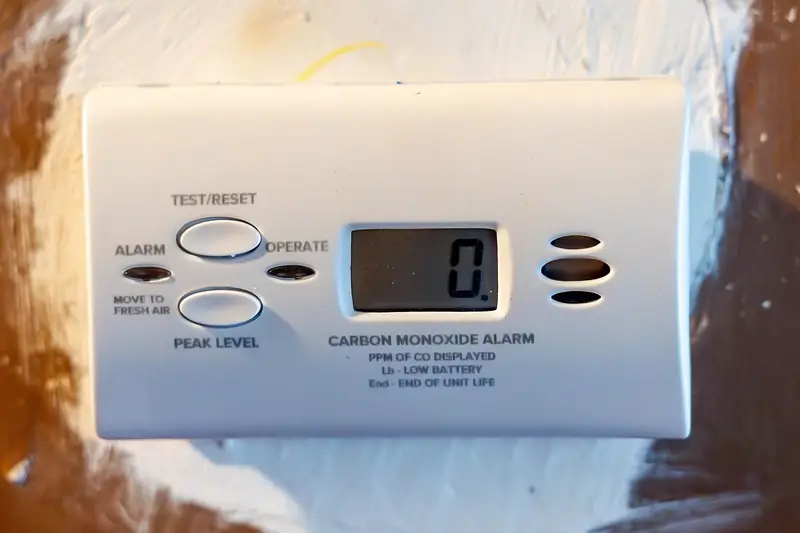
- A CO alarm, or anyone with a headache, dizziness or nausea: everyone outside, then call 911.
- Turn nothing on. If the boiler or furnace switch is on your way out, you can switch it off; never go toward smoke to reach it.
- Don't press the burner reset when there's a strong oil or exhaust smell.
- Stay out until responders say it's safe.
- If you're unsure, stop and call your supplier or a licensed technician.
First tap of the season
- Burner maker Beckett says unusual odors or staining around the heating appliance mean calling a technician immediately.
- Weil-McLain's owner check says oil leaks at the piping or around the burner also call for your service technician right away.
- Maine DEP names corrosion, mostly from the inside out, as the leading cause of heating oil tank spills at single-family homes in Maine.
- Vermont's AST Rules (effective August 1, 2024) treat a spill over 2 gallons, or strong petroleum vapors near the tank, as something to report immediately.
- The New York State Department of Health says to report any fuel oil spill, however small, to the NYSDEC Spill Hotline.
- NYS DOH says breathing heating oil odors can cause short-term headaches, nausea, dizziness and shortness of breath.
What causes an oil smell in the house?
Most oil smells come from one of three places: the burner, the tank and its lines, or a spill. A burner that isn't firing cleanly can leave a smell of oil or exhaust and soot around the boiler. Beckett tells homeowners that "unusual odors or staining around the heating appliance" mean a technician should come right away.
The tank side is slower and quieter. Maine DEP says corrosion, mostly from the inside out, is the leading cause of spills from home heating oil tanks, as water and sludge settle on the tank bottom and eat the steel. Weeps at the filter, fittings and valves, and oil around the gauge, are other common spots on its checklist. The oil tank leak page goes deeper on tank failures.
Deliveries can cause a smell too: Maine DEP warns that a broken vent whistle can lead to an overfill. A smell after a fill is worth a same-day call to the dealer.
When does an oil smell mean get out?
Get out when there's smoke, soot or a CO alarm, or when anyone in the house feels ill. Smoke or soot puffing from the burner can mean unburned oil or vapor igniting in the combustion chamber, and the burner makers' manuals warn against starting a burner when the chamber holds excess oil or is full of vapor. Leave, then call 911 from outside.
A CO alarm changes everything, smell or no smell. The carbon monoxide page covers what to do, and the short version for an oil home is the same as for any other: everyone outside, 911 from outside, nobody back in until responders say so.
Symptoms count even without an alarm. New York's health department says breathing heating oil odors can cause headaches, nausea, dizziness and shortness of breath. If people feel sick, take them outside first and sort out the smell from there.
What can you check safely?
You can look, and you can read the situation, without touching anything. Maine DEP's tank checklist ends with four words worth keeping: "Please look - don't touch." From a few feet away, note whether the burner is running or stopped, and whether there's oil on the floor, under the tank, or on the lines.
These are the signs Maine DEP asks homeowners to look for:
- A tank that's leaning, unstable or on an unstable base.
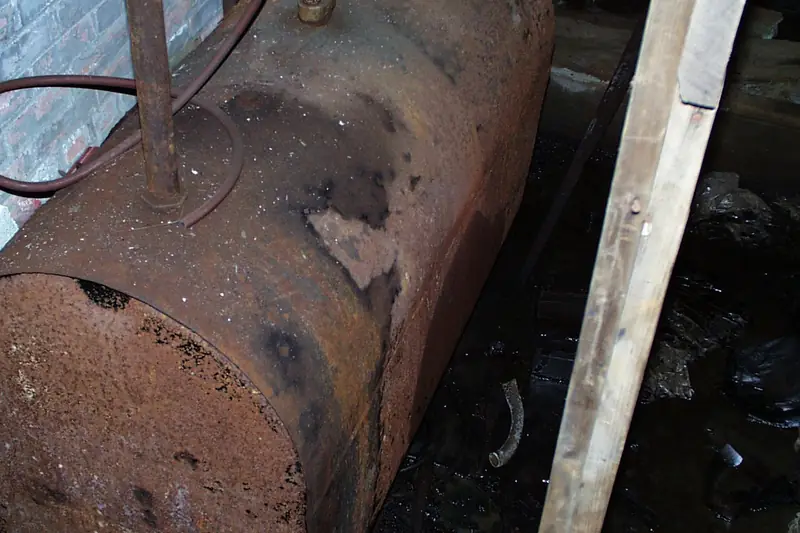
- Rust, weeps, wet spots or heavy dents on the tank surface.
- Drips or signs of leakage around the filter, valves or fittings.
- A gauge that's cracked, stuck or frozen, or oil and staining around it.
If the burner has stopped and the house is getting cold, the reset button is tempting. Don't press it when you can smell oil or exhaust at the boiler: Weil-McLain says a burner must never be fired with oil in the combustion chamber. If there's no smell and it simply quit, the oil burner reset button page explains the one press that's allowed, and when to stop.
Who do you call about an oil smell?
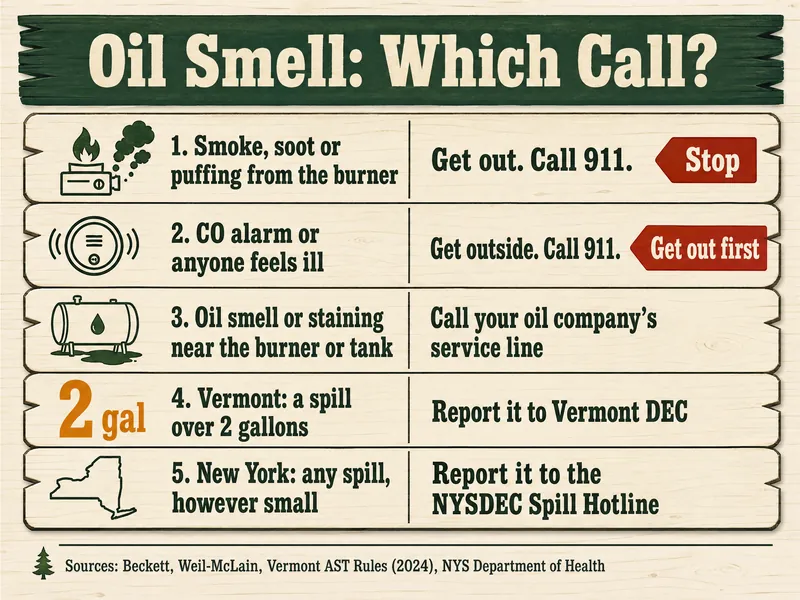
For smoke, fire or a CO alarm, call 911. For a smell, staining or a drip with no smoke, call your oil company's service line and say what you see. Weil-McLain's weekly owner check says that if you find oil leaks in the piping or around the burner, "immediately call your service technician to repair."
Spills add a state call. In Vermont, the AST Rules require an immediate report of a release over 2 gallons, or a suspected release such as an unusual loss of oil or strong petroleum vapors near the tank. Reports go to the Department of Environmental Conservation's Waste Management & Prevention Division on weekdays, or Vermont Emergency Management at any hour. In New York, NYS DOH says to report any spill, no matter how small, to the NYSDEC Spill Hotline, and to tell your oil delivery company and your insurance company.
In Maine and New Hampshire, tell your oil dealer and your state's environmental agency: the Maine Department of Environmental Protection or the New Hampshire Department of Environmental Services. Look up the agency's spill line before winter and keep it with the dealer's number.
| What you notice | What it can mean | Who to call |
|---|---|---|
| Smoke or soot puffing from the burner | Unburned oil or vapor igniting | 911, from outside |
| CO alarm, or people feeling ill | Exhaust getting into the house | 911, from outside |
| Oil smell or staining near the burner | Burner or piping problem | Oil company's service line |
| Drips, wet spots or rust on the tank | Tank or fitting leak | Oil company; in Vermont, report a suspected release |
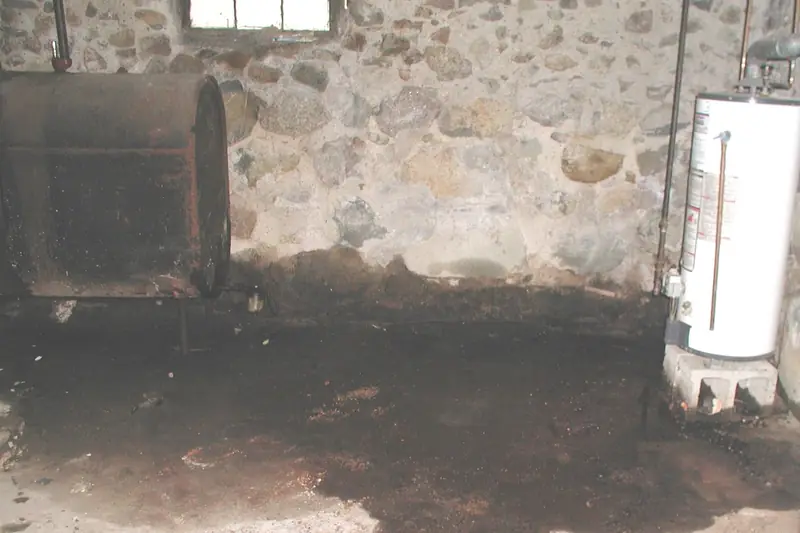
| Oil on the floor | A spill | Oil company and your state's environmental agency |
What if oil spilled?
Keep people and pets away from it, don't run the burner, and make the calls. How much and where it spilled decides who comes: the oil company for the equipment, and the state agency for the spill itself in Vermont and New York, under the rules above.
Tell your insurance company early. New York's health department says to notify both your oil delivery company and your insurer. Whether a policy pays for cleanup varies, so ask; Fill Pipe has no source that answers it for every policy.
How does the smell get cleared afterward?
The smell goes when its source is fixed, so the first step is the repair, not air freshener. Once the technician finds a leaking fitting, a failed seal or a burner that needs adjusting, the oil stops and the smell fades. A spill on concrete or a dirt cellar floor is a cleanup job for the oil company, working with your state agency where the spill is reportable.
Then keep it from coming back. Oil burner makers including Beckett, Riello and Weil-McLain call for service by a qualified technician every year, and Weil-McLain's checklist includes checking the chimney or vent, cleaning flue ways, changing the nozzle and filter, and testing combustion. Vermont requires an oil tank inspection at least every four years. The yearly service page explains what that visit should cover, and tank replacement covers what Maine DEP says about older steel tanks.
Board feet: the numbers
- 2 gallonsspill size Vermont requires to be reported immediatelyVermont AST Rules
- 4 yearsmost time allowed between inspections of a Vermont home oil tankVermont DEC
- 1+home heating oil spills a day in Maine (more than one)Maine DEP
- 1 yearinterval for professional oil burner serviceBeckett
Scaler's notes: how this page was put together
This page is based on Beckett's oil burner overview and AF burner manual, Weil-McLain's Series 3 and WGO Series 4 boiler manuals, Riello's 40 Series owner instructions, Maine DEP's tank checklist, Vermont's Aboveground Storage Tank Rules (effective August 1, 2024) and DEC heating-tank page, and the New York State Department of Health page on home heating oil spills, all read in October 2026. Left out: Maine and New Hampshire spill-reporting deadlines and phone numbers (their pages couldn't be read), cleanup methods, insurance coverage claims, and any burner repair steps.
Questions from the woodshed
Is a faint oil smell near the boiler normal?
Beckett treats unusual odors around the heating appliance as a reason to call a technician immediately, so don't decide on your own that it's normal. Call the service line and describe when the smell appears, such as at startup or all the time.
Why does the house smell of oil right after a delivery?
It can mean oil got out at the fill or vent pipe, or an overfill if the vent whistle didn't work. Maine DEP says broken whistles can cause overfills. Call the dealer the same day and ask them to check.
Can I press the reset if the burner stopped and the basement smells of oil?
No. Weil-McLain says a burner must never be fired when oil is in the combustion chamber. Leave it off and call for service.
What is a puffback?
It's the term people use when a burner puffs smoke and soot into the room. No maker manual Fill Pipe read uses the word, so treat it simply as smoke from the burner: get out, call 911, then the oil company.
Do I report a small drip under the tank?
In Vermont, an unusual loss of oil or strong vapors near the tank counts as a suspected release to report. In New York, NYS DOH says to report any spill. Everywhere, call the oil company to look at the tank.
Can heating oil fumes make you sick?
New York's health department says breathing heating oil odors can cause short-term headaches, nausea, dizziness and shortness of breath. Because those match carbon monoxide symptoms too, anyone who feels ill means everyone outside, then call 911 from outside.
More on oil and safety

Back to the Fill Pipe home page