The 275-Gallon Oil Tank
The 275 gallon oil tank is the standard steel cellar tank in oil-heated homes; 275 is its nominal size, not what a delivery puts in, and its gauge and whistle tell you the rest.
Written by the Fill Pipe desk from state, federal and maker documents · how the pages are made · Updated
Who’s behind the links: Fill Pipe is run by the people who own Plumbing Supply and More, SoftPro Water Systems and Quality Water Treatment, and it has a working tie to Central Plumbing & HVAC. No business pays to appear here. Figures and safety steps on this page come from state energy offices and environmental agencies, federal agencies (EIA, IRS, CPSC, CDC), the propane and heating-oil industries' own safety programs, and equipment makers' manuals, read in October 2026. Fill Pipe sells no fuel and services no equipment. Owners and outbound links
First tap of the season
- "In homes, 275-gallon steel tanks are commonly used for heating oil," says the DOE/NREL biodiesel handling manual.
- 275 gallons is nominal; for the most a delivery should put in, ask your dealer or check the tank label for its fill limit.
- Scully, which makes tank whistles, says the whistle sounds while the tank fills and the tank is full when it stops.
- Maine DEP says broken whistles can lead to overfills, because drivers rely on the whistle stopping.
- Under Maine AG Chapter 100, owners of a standard 275-gallon tank must order at least 100 gallons to avoid a delivery surcharge of up to $20.
- Maine DEP's timeline for a steel tank: planning begins after year 20, and replacement comes as it nears 25.
Stop and call
- Oil on the floor, a wet spot, or a drip from the filter, valve or fittings: look, don't touch, and call your oil dealer.
- A strong oil smell, smoke or soot puffing from the burner: turn nothing on, leave if smoke fills the space and call 911; otherwise call your oil company's service line.
- The whistle stays silent during a fill: tell the driver at once.
- Out of oil: don't try to restart the burner; call for a delivery and for service.
- If you're unsure, stop and call your supplier or a licensed technician.
What is a 275 gallon oil tank?
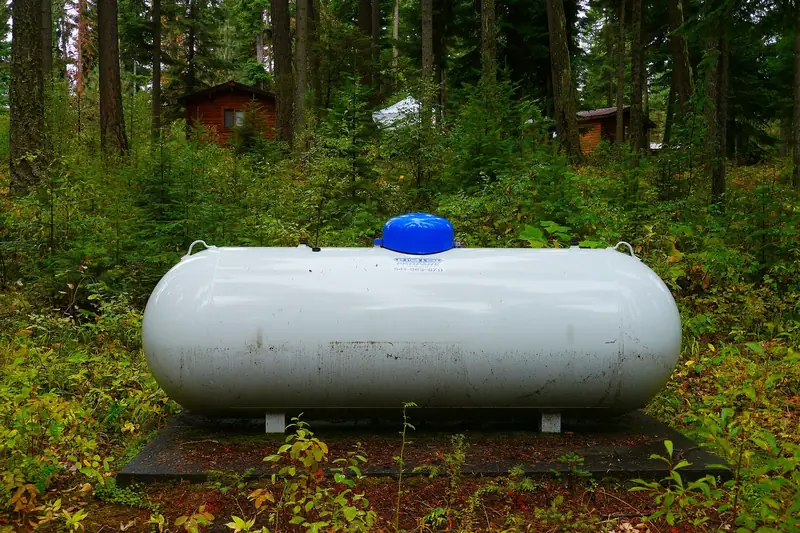
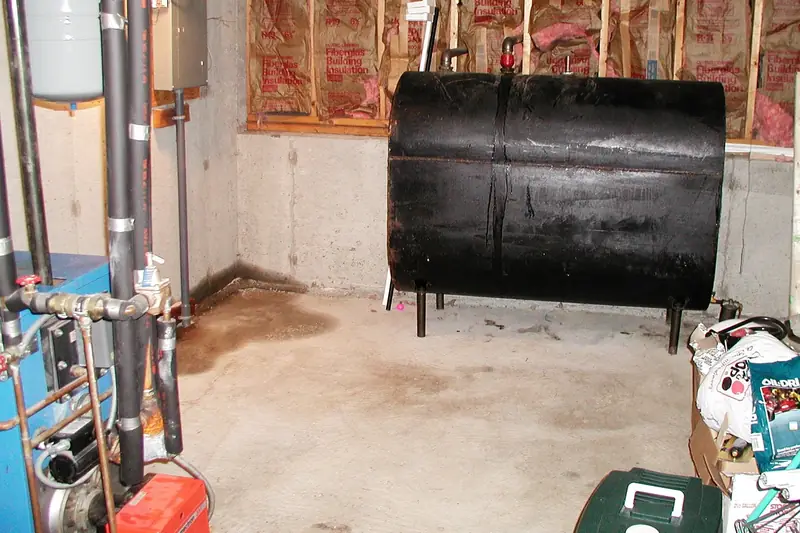
A 275 gallon oil tank is the common steel heating oil tank in homes across Maine, New Hampshire, Vermont and New York, usually standing on legs in the basement. The DOE/NREL manual names it as the usual home size and adds that newer plastic tanks with steel outer enclosures are also being installed. Scully's catalog lists gauges for 275-gallon tanks 44, 42 and 27 inches deep and whistles for "275 gal. vertical and flat tanks," so the same nominal size comes in more than one shape.
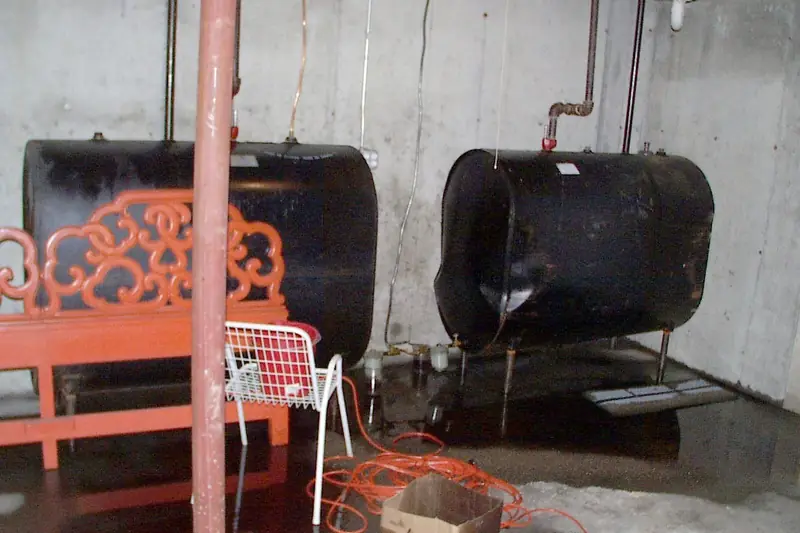
Treat 275 as the size class, not a fill figure. We found no maker or state source giving a usable or safe-fill volume, so we don't print one; your dealer or the label on the tank can tell you the fill limit for yours. Some homes run two tanks side by side, and Scully sells a gauge for "550 gallon-Twin 275s."
How do you read the oil tank gauge?
Read the window on top of the tank: the float inside rises and falls with the oil and shows the level in gallons or inches, depending on the model. Scully's catalog says its float gauges come with "Measurement readings available in gallons or inches," that the gauge "is calibrated at the factory and should not be recalibrated in the field," and that it is "Not intended for use as an overfill prevention device."
If your gauge isn't marked in gallons or inches, ask your dealer how to read it rather than guessing; we found no maker text that turns other markings into gallons. Check the gauge itself while you're there. Maine DEP's check-your-tank questions ask whether the gauge is "cracked, stuck, or frozen" and whether you see oil or staining around it, and add: "Please look - don't touch." Vermont's AST Rules require every new tank to have a device to gauge fuel volume.
Why does the vent whistle during a fill?
The whistle is how the driver knows the tank is full: it sounds through the vent while oil goes in and goes quiet when the tank is full. Scully, the maker, puts it this way: "They whistle when the tank is filling. When the whistle stops, the tank is full." Its calibrated whistle stems leave room for the oil to expand.
A whistle that doesn't sound is a spill risk. Maine DEP says "Broken whistles can result in overfills and over pressurization as delivery drivers rely on the whistle stop to signal a full tank," and that a blocked vent can cause a silent whistle; if you're not sure, ask your delivery driver. In Vermont, every tank must have a working alarm or whistle or it gets a red tag, and the AST Rules require vent pipes to end no more than 12 feet from the fill pipe at a point visible from the fill port.
Some tanks carry a combined whistle and level gauge in one fitting, which Scully sells as the Ventalarm. If your technician says the whistle or gauge needs replacing, the product below shows what that kind of fitting looks like; fitting it, and sizing it to the tank opening, vent pipe and tank depth, is the technician's job.
How long does a fill last?
A fill lasts as long as your house takes to burn it, which depends on the weather, the house and the burner, so no fixed number applies; your own delivery tickets give the real answer. Divide the gallons on one ticket by the days until the next delivery and you have your gallons per day at that time of year. Keep a winter's worth of tickets and the pattern shows when to call.
Maine's rules shape order size. Under the Maine AG's Chapter 100 heating oil rules, in effect October 15 to April 30, a dealer may add a surcharge of up to $20 if you order less than 50% of your tank's capacity or 100 gallons, whichever is less, and the AG says owners of a standard 275-gallon tank must order at least 100 gallons to avoid it. The same page advises watching the fuel level and calling a reasonable time ahead to avoid costly emergency deliveries. If you do run dry, the ran out of heating oil page covers what happens next; the burner usually needs a technician to restart. The heating oil delivery plans page compares automatic and call-in delivery.
| Part | What it does | What the source says |
|---|---|---|
| Fill pipe | Where the driver connects the hose | Vermont: at least 1¼ inches, metallic |
| Vent pipe and whistle | Lets air out and signals a full tank | Scully: when the whistle stops, the tank is full |
| Gauge | Shows the oil level | Scully: gallons or inches; not an overfill device |
| Filter and oil line | Carry oil to the burner | Maine DEP: watch for drips; buried lines need a sleeve |
| Legs and base | Hold the tank steady | Maine DEP: check for leaning or an unstable base |
Where should the tank sit?
The tank should sit level on a stable base, protected from falling snow and ice, with its oil line protected where it runs through concrete. Maine DEP's checklist asks whether the tank is "leaning, unstable, or on an unstable base" and whether snow or ice can fall on the tank, filter or piping, noting that a filter protector can help. Vermont DEC requires tanks installed after August 15, 2017 to sit on a solid foundation at least 4 inches thick whose footprint exceeds the tank's by 10%.
Oil lines matter as much as the tank. Maine DEP says an unprotected oil line buried in a basement floor can corrode and must be replaced if it has no sleeve, and Vermont requires buried lines to be coated or sleeved. Granby, a tank maker, says a tank installed indoors is known on average to last longer than one outdoors, and that all tanks must be installed by licensed installers. Placement of a new tank is a job for that installer, following your state's rules.
How do you know it is aging?
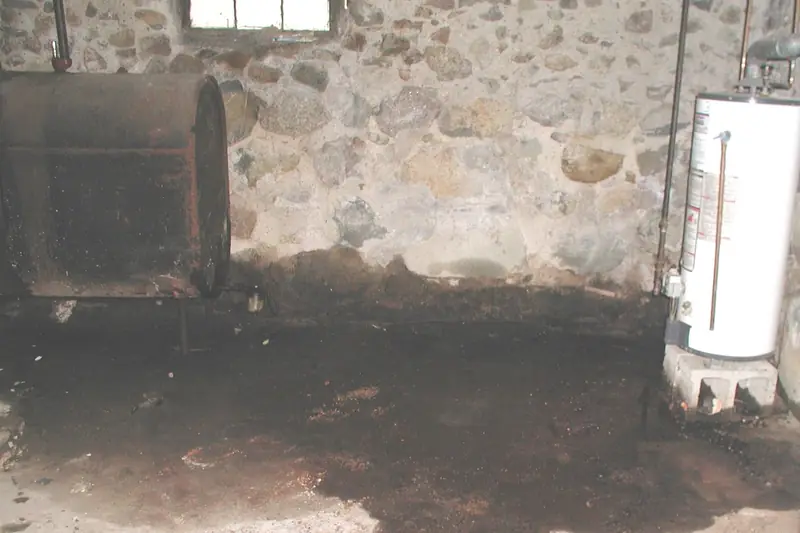
Look for rust, weeps, wet spots, dents and patches, and find out the tank's age; Maine DEP says to replace a tank that is approaching 25 years old. Maine DEP says corrosion, mostly from the inside out, is the leading cause of spills from home heating oil tanks in Maine: water and sludge settle at the bottom and slowly eat the steel. That means the outside can look fine while the bottom thins.
Maine DEP adds that crimped tank ends are usually weaker than modern capped ends and usually mean the tank dates from 1999 or earlier. Ultrasonic thickness testing can help on tanks under 20 years old; past 20, DEP says it may no longer be effective and it's time to consider replacement. The oil tank replacement page covers timing, rules and help by state, and the oil tank leak page covers what to do if you find oil. For an oil smell in the house, see the oil smell page.
275-gallon tank numbers
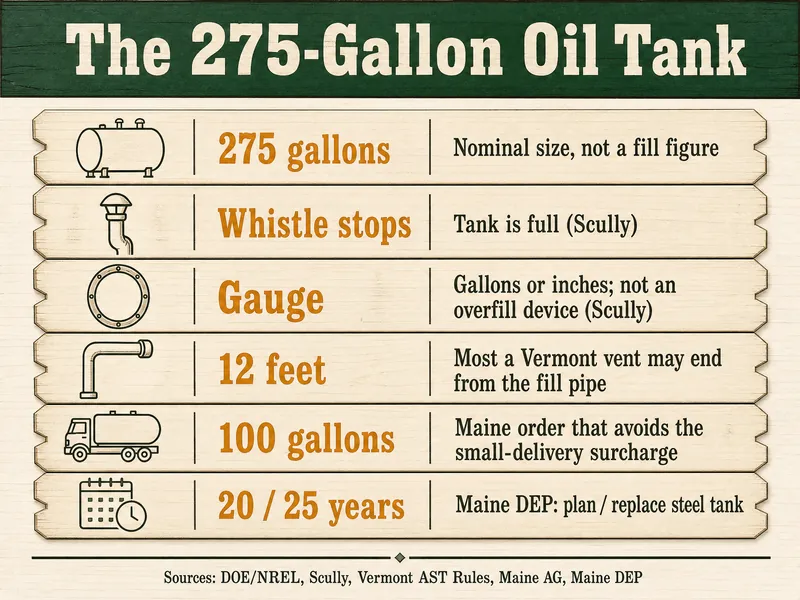
- 275gallons, the usual home oil tank (nominal)DOE/NREL
- 100gallons, the order that avoids Maine's small-delivery surcharge on a 275Maine AG
- 12 feetmost a Vermont vent may end from the fill pipeVermont AST Rules
- 20 yearspoint to start planning a replacementMaine DEP
Scaler's notes: how this page was put together
This page draws on the DOE/NREL biodiesel handling manual, Scully's tank-fill catalog, Maine DEP's check-your-tank and spill pages, the Maine AG's Chapter 100 heating oil page, the Vermont heating-tank rules and DEC web page, and Granby's residential tank page, read in October 2026. We left out any usable or safe-fill volume for a 275-gallon tank, any gallon value for gauge markings and any gallons-per-day figure, since none of the primary documents we read offers one. The partner product is shown so you can recognize the part, not as something to install.
Questions from the woodshed
How many gallons can a delivery put in a 275-gallon tank?
Less than 275, but we found no primary source giving the exact limit, so ask your dealer or check the tank label for its fill limit. The driver stops when the whistle stops, which leaves room for the oil to expand.
Is a 275-gallon tank vertical or flat?
Both exist. Scully sells whistles "for 275 gal. vertical and flat tanks" and gauges for 275-gallon tanks 44, 42 and 27 inches deep, so check yours before ordering any part.
Why is there oil staining around my gauge?
Maine DEP lists staining around the gauge among the warning signs on its tank checklist. Don't touch or tighten anything; call your oil dealer or service company to look at it.
Does a cellar tank need a concrete pad?
In Vermont, tanks installed after August 15, 2017 need a solid foundation at least 4 inches thick, and older ones need a stable foundation. Maine DEP's checklist flags any tank that leans or sits on an unstable base.
Are plastic-lined tanks replacing all-steel ones?
The DOE/NREL manual says newer plastic tanks with steel outer enclosures are being installed, and Vermont's rules allow that design for new tanks. Which suits your house is a question for your installer.
My whistle didn't sound at the last fill. What now?
Tell your dealer before the next delivery. Maine DEP says a blocked vent can silence the whistle and a broken one can lead to an overfill, and in Vermont a tank without a working whistle gets a red tag.
Keep reading